The Alarming Transformation of New Zealand's Southern Alps: A Red Awakening
2025-04-24
Author: Yan
Red Snow? The Unexpected Truth Behind New Zealand's Alps
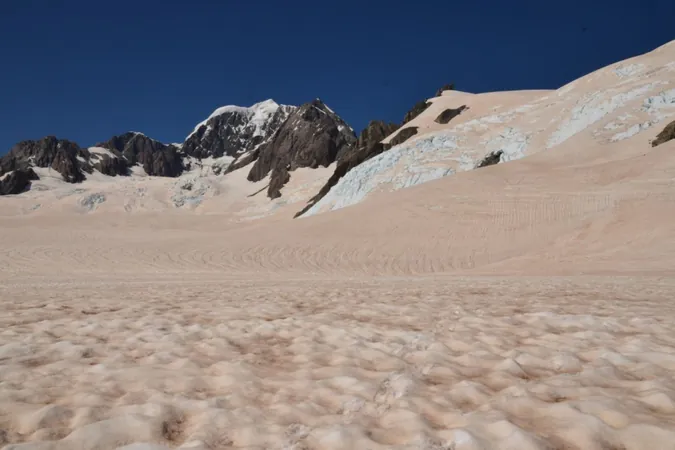
In a shocking turn of events during the Southern Hemisphere's summer of 2019-2020, New Zealand's majestic Southern Alps were painted an alarming shade of red. Recent research has unveiled the startling reason behind this unusual phenomenon.
A massive dust storm originating from southeast Australia was responsible for this eye-catching transformation, depositing approximately 4,500 tons of red dust onto the snowy peaks. This groundbreaking revelation, detailed in a study published in *Geophysical Research Letters*, challenges the previously held belief that the discoloration was caused by ashes from devastating bushfires.
Set the Record Straight: Dust vs. Ash
Holly Winton, an environmental scientist at Te Herenga Waka—Victoria University of Wellington and lead author of the study, clarified the timeline. "Media reports in 2020 often linked the vibrant red to the ash from the New Year bushfires, but in reality, this red dust arrived long before that," Winton explained.
The researchers employed time-lapse cameras, air mass tracking, snow impurity geochemistry, and remote sensing to trace the origins of the red contamination back to late November 2019.
The Melting Consequences
Although fresh snowfall soon buried the red dust, it melted in early 2020, coinciding with a stunning display of vibrant skies from the bushfires. This led to a media frenzy linking the two events.
A Warning for the Future
The study highlights that the primary cause of the glacier's discoloration was a desert dust storm from southeast Australia, spurred by the same meteorological conditions that fueled the catastrophic bushfires.
This layer of dust significantly affected the Alps by diminishing the snow's ability to reflect sunlight. Instead, the dust absorbed heat, leading to increased surface temperatures and accelerated melting of snow and ice.
Climate Change: A Long-term Threat
Phil Novis, a co-author and phycologist from Manaaki Whenua Landcare Research, warned that climate change is likely to enhance desertification and dryness in various regions, making such dust storms and wildfires more frequent. He noted, "The 2019-2020 incident marks at least the ninth documented event in New Zealand since 1902, and it's undoubtedly one of the most dramatic."
This study serves as a stark reminder of the less visible consequences of climate change, urging leaders to take necessary actions to mitigate its effects on our environment.


 Brasil (PT)
 Canada (EN)
 Chile (ES)
 Česko (CS)
 대한민국 (KO)
 España (ES)
 France (FR)
 Hong Kong (EN)
 Italia (IT)
 日本 (JA)
 Magyarország (HU)
 Norge (NO)
 Polska (PL)
 Schweiz (DE)
 Singapore (EN)
 Sverige (SV)
 Suomi (FI)
 Türkiye (TR)
 الإمارات العربية المتحدة (AR)