The Webb Telescope's Stellar Discoveries Face Survival Threat Amid Political Turbulence
2025-04-23
Author: Kai
A Million Miles Away, Yet Caught in Political Crosshairs
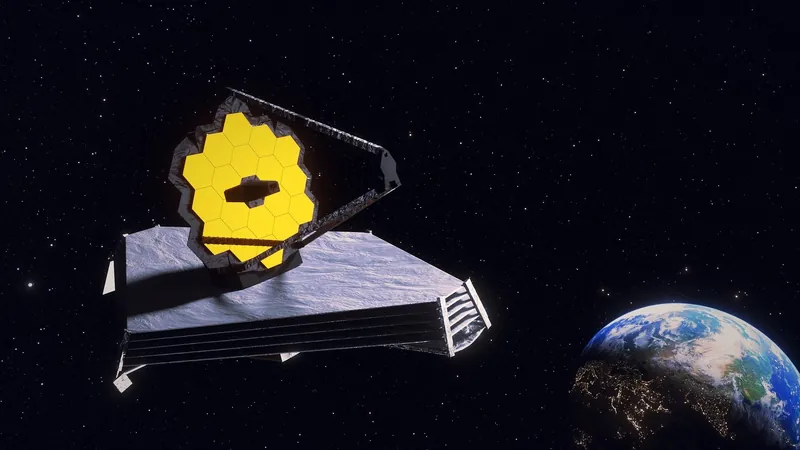
As political unrest stirs up chaos back home, many Chicagoans find themselves longing for an escape—if only an astronaut could whisk them away into the cosmos. But even the brilliant James Webb Space Telescope, stationed a million miles from Earth, isn't immune to the grip of politics.
Unveiling Cosmic Wonders
The $10 billion Webb Telescope, affectionately known as "Webb," has been operational for nearly three years and has already made groundbreaking discoveries. Using infrared technology, it reveals the fascinating processes of star and galaxy formation while providing crucial insights into the atmospheres of distant exoplanets. It stands as a powerful complement to the aging Hubble Space Telescope.
Startling Findings and Their Implications
Among its notable achievements, Webb has documented the slow-motion spectacle of a star consuming a planet and tracked a high-speed asteroid heading toward Earth—luckily, it will miss us! You’d think leaders would cherish such advancements, yet the telescope's future hangs in the balance.
A Budget Battle Brewing
The political landscape, particularly under the Trump administration, poses a serious threat to NASA and its scientific endeavors. With significant budget cuts proposed for NASA’s Science Mission Directorate, the future of Webb and other critical projects, like the Nancy Grace Roman Space Telescope, could be jeopardized.
A Call for Scientists
While funding for both the Hubble and Webb projects remains in the proposed budget, a severe reduction in NASA’s scientific workforce could render these amazing tools ineffective. According to astrophysicist Daniel Holz, without a strong team of scientists, the potential for unlocking discoveries diminishes significantly.
Impacts Beyond the Telescope
These funding cuts aren’t isolated; they're symptomatic of a broader campaign against scientific inquiry across various sectors. Scientists face pressure that could disrupt critical long-term research essential for addressing issues ranging from climate change to public health.
The Global Stakes
The ramifications extend far beyond national borders. With countries like China and members of the EU racing to leapfrog the U.S. in scientific advancement, reducing investment in space exploration could leave America trailing behind in this crucial arena.
The Doomsday Clock Ticks
Amidst this turmoil, Holz, who also sets the Doomsday Clock for the Bulletin of Atomic Scientists, warns that the world faces increasing risks—whether from climate-induced chaos, pandemics, or unchecked AI. The clock now stands at its closest point to midnight in 80 years, emphasizing the gravity of the current moment.
What Lies Ahead?
As debates about the future of space research unfold, the potential for critical advancements hangs in the balance. With the specter of these politically motivated cuts looming large, the scientific community fears that the path to resilience against future threats may be obstructed. If the Doomsday Clock moves again, let's hope it’s not inching closer to catastrophe.



 Brasil (PT)
 Canada (EN)
 Chile (ES)
 Česko (CS)
 대한민국 (KO)
 España (ES)
 France (FR)
 Hong Kong (EN)
 Italia (IT)
 日本 (JA)
 Magyarország (HU)
 Norge (NO)
 Polska (PL)
 Schweiz (DE)
 Singapore (EN)
 Sverige (SV)
 Suomi (FI)
 Türkiye (TR)
 الإمارات العربية المتحدة (AR)