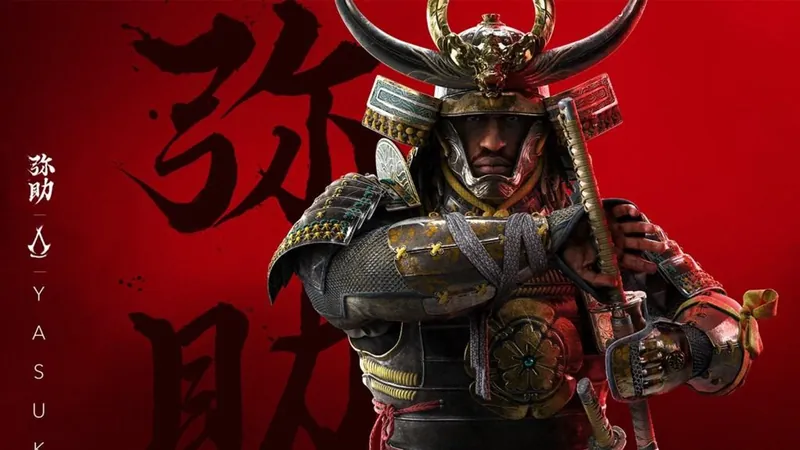
The Yasuke Dilemma: Can Assassin’s Creed Shadows Balance Character Design with Gameplay?
2025-03-25
Author: Ken Lee
Introduction
In the whirlwind of controversies surrounding the release of "Assassin's Creed Shadows," few issues have sparked as much debate as the inclusion of historical figure Yasuke, a black samurai. Since the game's announcement, conversations about racial representation, historical accuracy, and character portrayal have erupted, leading to polarizing opinions among fans and critics alike.
The Yasuke Debate
Unlike typical character discussions, the debate about Yasuke has led to accusations questioning his legitimacy as a samurai, with some arguing that the game should have chosen a wholly Japanese character as its protagonist instead. As the game has launched, fresh controversies have surfaced—ranging from Yasuke's ability to seduce royal figures to the inclusion of a non-binary character.
Character Design vs. Gameplay
However, delving deeper, the crux of the matter goes beyond these surface-level debates. While Yasuke enriches the story with his unique narrative, the gameplay seems to struggle with his character’s design. Ubisoft has opted for a dual-character system, one that not only divides by gender, but by contrasting playstyles, which can lead to awkward and frustrating gameplay moments.
Yasuke’s Combat Style
Yasuke, characterized as a brute force warrior, excels in close combat, swinging oversized katanas and maces through enemy ranks. His combat style strips away the subtlety typically associated with Assassin's Creed, leaning instead toward a more action brawler experience. Yet, this divergence creates a paradox; Yasuke's brawny, direct approach conflicts with the stealth-based core that many fans love about the series.
Traversal Challenges
Sadly, the game world around Yasuke doesn’t seem designed to accommodate his imposing presence. Traversing the environment becomes a chore as players experience the limitations of his character. Scenes where Yasuke eliminates foes in a temple quickly devolve into frustration when players realize they must switch to the agile character Naoe to reach higher platforms or complete certain objectives. This constant need to switch characters disrupts the flow of gameplay, highlighting a disconnect in the game’s design.
Comparative Analysis
Using the recent character advancements seen in titles like "Assassin's Creed Valhalla," where characters like Eivor and Kassandra can effortlessly navigate both stealth and combat, one would think a balanced approach could have been applied here. Instead, Yasuke often feels like he was designed for a different game altogether, with segments of "Shadows" appearing tailored to him, while others appear more aligned with Naoe’s skill set.
Conclusion
In summary, while Yasuke’s storyline adds a captivating layer to "Assassin's Creed Shadows," the struggle to integrate his character seamlessly into the game world becomes a point of contention. As players delve into this latest adventure, they will encounter moments of exhilarating combat and irksome traversal—prompting reflection on how character design affects overall gameplay experience.


 Brasil (PT)
 Canada (EN)
 Chile (ES)
 Česko (CS)
 대한민국 (KO)
 España (ES)
 France (FR)
 Hong Kong (EN)
 Italia (IT)
 日本 (JA)
 Magyarország (HU)
 Norge (NO)
 Polska (PL)
 Schweiz (DE)
 Singapore (EN)
 Sverige (SV)
 Suomi (FI)
 Türkiye (TR)
 الإمارات العربية المتحدة (AR)