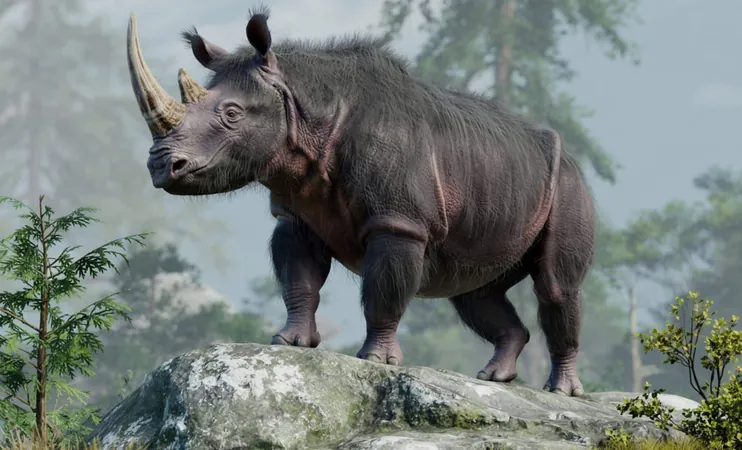
Unearthing the Rhinoceros Super-Herd: A Terrifying Story of Mass Death and Survival!
2025-04-21
Author: Wei
A Prehistoric Catastrophe Unfolds
Over 11.8 million years ago, more than 100 ancient rhinoceroses met their fate in a chilling event that has left scientists astounded. Their fossils, discovered at Nebraska's Ashfall Fossil Beds, are turning our understanding of prehistoric megafauna on its head!
In a groundbreaking study published in *Scientific Reports*, researchers revealed that a cataclysmic eruption from the Yellowstone supervolcano was behind this mass extinction, blanketing the area in ash and leading to a prolonged and agonizing demise for these large creatures.
The Supervolcanic Eruption: A Time Capsule of Doom
The Ashfall site acts as a haunting time capsule, preserved by a thick layer of volcanic ash that captures a devastating moment in history. Approximately 11.86 million years ago, an eruption on a colossal scale sent around 650 cubic kilometers of ash cascading into the atmosphere, choking life in the Midwest.
Unlike the swift deaths witnessed in places like Pompeii, the rhinoceroses didn't die instantly. Instead, they faced a slow and painful decline as the ash smothered vegetation, darkened the skies, and polluted water sources, leading to a heartbreaking struggle for survival.
A Unique Social Structure Revealed
Modern rhinos are typically solitary creatures, but the evidence from Ashfall tells a different story. The majority of the skeletons discovered were female, young, and immature, while dominant males were conspicuously absent. This demographic pattern points to a polygynous mating system where dominant males controlled the herd.
Using sophisticated isotope analysis of tooth enamel, researchers have peeled back the layers of the rhinoceroses' lives, revealing startling insights into their diets, water sources, and movement patterns. Amazingly, the findings suggest these animals didn’t migrate or disperse during their lifetime, living in a relatively small area.
Teleoceras: The Semi-Aquatic Giants
The Teleoceras species, with their barrel-shaped bodies and high-crowned molars, likely led a semi-aquatic lifestyle much like modern hippos. Adapted to live in wetland environments, they grazed on grasses and foliage, avoiding the need for seasonal migration.
Previous studies have also indicated that these rhinos had a diet rich in C3 grasses, suggesting they relied on stable water sources and abundant vegetation rather than roaming in search of food.
Challenging Assumptions About Ancient Behavior
To explore whether these rhinos might have migrated due to the eruption, researchers analyzed tooth enamel samples over time. However, the findings revealed no significant dietary or locational changes.
In a fascinating comparison, the isotope values of Teleoceras were found to be distinct from other species at the site, highlighting their preference for moist habitats contrasted with the drier habitat choices seen in horses and camels. This supports the idea that they were not long-distance migrants, but rather local residents thriving in their watery domains.



 Brasil (PT)
 Canada (EN)
 Chile (ES)
 Česko (CS)
 대한민국 (KO)
 España (ES)
 France (FR)
 Hong Kong (EN)
 Italia (IT)
 日本 (JA)
 Magyarország (HU)
 Norge (NO)
 Polska (PL)
 Schweiz (DE)
 Singapore (EN)
 Sverige (SV)
 Suomi (FI)
 Türkiye (TR)
 الإمارات العربية المتحدة (AR)