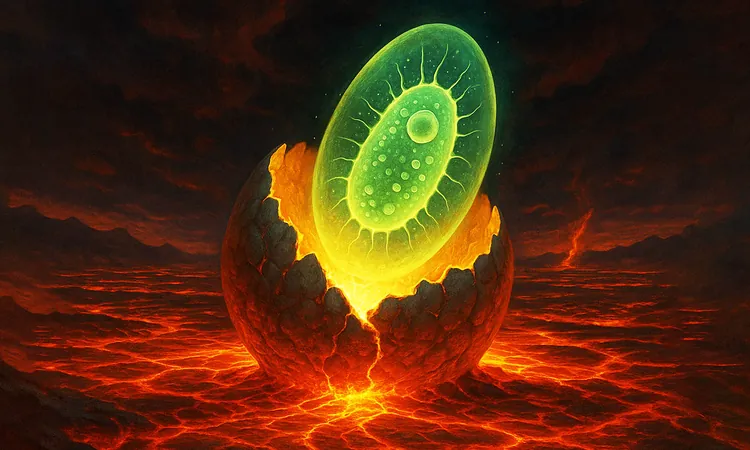
Unlocking Earth's Secret: Meet LUCA, Our Ancient Universal Ancestor!
2025-04-19
Author: Ming
The Mystery of Life's Origins
Imagine a world where every leaf, feather, and microbe is linked by the same genetic code! This incredible idea stems from the discovery of LUCA—the Last Universal Common Ancestor—an ancient organism from which all life on Earth can trace its lineage.
One Genetic Code, Countless Possibilities
Why does the genetic code appear almost identical across all living beings? The surprising answer lies in LUCA, which existed at the critical junction between Bacteria and Archaea. Dr. Edmund Moody and his team from the University of Bristol embarked on a journey through thousands of genomes to pinpoint LUCA's genetic makeup.
Their research unveiled approximately 2,600 genes—smaller than previous estimates but significant in understanding early life. These genes provided LUCA with the tools necessary for survival, replication, and adaptation.
A Snapshot of LUCA's Abilities
LUCA wasn’t just a simple organism. The intricate genetic toolkit included essential functions like DNA repair and energy production, indicating a self-sustaining life form that thrived independently. This challenges the notion that early life was merely a passive component of an evolving planet.
Survival in Extreme Conditions
Dating back 4.2 billion years, LUCA emerged when Earth was a tumultuous place, frequently bombarded by asteroids and volcanic eruptions. However, hydrothermal vents likely provided a unique environment for LUCA, rich in the minerals essential for its survival. Recent studies suggest that LUCA's adaptations allowed it to harness the energy around it, showcasing survival instincts we often see in modern microbes.
An Arms Race with Viruses
An astonishing revelation is that LUCA may have had a rudimentary immune system, battling viruses that appeared alongside it! These early gene defenses hint at an evolutionary arms race, pushing LUCA and its kin towards innovation—laying the groundwork for the diverse life forms we see today.
Microbial Neighborhoods: A Complex Ecosystem
LUCA likely didn’t go it alone; it was part of a thriving microbial community. Its waste became food for other organisms, establishing an early recycling ecosystem. This interaction balances the dynamics of ancient environments, laying the foundation for complex life.
Why Understanding LUCA Matters
The discoveries surrounding LUCA provide insights not only into our own evolutionary history but also into the potential for life beyond Earth. The research underscores the rapid establishment of ecosystems on early Earth, hinting that life could be flourishing on similar planets across the universe.
What Lies Ahead in the Search for Life?
The quest doesn't stop here! Each new genomic discovery adds more pieces to LUCA's puzzle. As technologies advance, scientists aim to further explore ancient gene families and the microbial ecosystems related to them. Fresh drilling missions to uncharted hydrothermal vents could unveil evidence of life forms reminiscent of those early biochemical pioneers.
In summary, the narrative of life is not one of timid beginnings but a bold resurgence with LUCA, equipped with the tools to battle challenges and thrive in diverse environments. Every organism living today carries a spark—a connection to that remarkable journey from primordial chaos to thriving complexity.



 Brasil (PT)
 Canada (EN)
 Chile (ES)
 Česko (CS)
 대한민국 (KO)
 España (ES)
 France (FR)
 Hong Kong (EN)
 Italia (IT)
 日本 (JA)
 Magyarország (HU)
 Norge (NO)
 Polska (PL)
 Schweiz (DE)
 Singapore (EN)
 Sverige (SV)
 Suomi (FI)
 Türkiye (TR)
 الإمارات العربية المتحدة (AR)