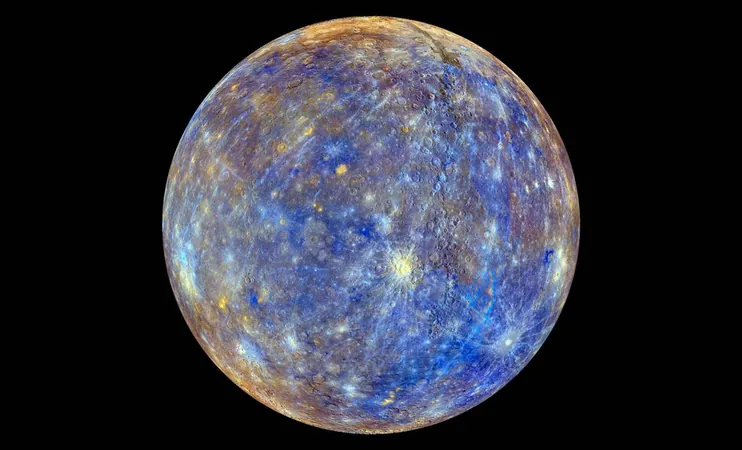
Unveiling Mercury's Hidden Treasure: A 10-Mile-Deep Layer of Diamonds!
2025-04-21
Author: Ming
Mercury, the smallest and hottest planet in our solar system, might be hiding a luxurious surprise beneath its bleak surface—a stunning layer of diamonds stretching up to 11 miles thick! This revelation comes from a trailblazing study led by Dr. Yanhao Lin, a planetary materials expert, published in *Nature Communications*. The findings suggest that the intense conditions deep inside Mercury could have transformed carbon into this dazzling crystalline structure, encasing its metallic core.
From Carbon-Rich Origins to Diamond Dreams
Scattered across Mercury's surface are traces of graphite, a form of carbon, hinting at a fiery past where the planet was once engulfed by a molten carbon-rich ocean. As it cooled, lighter carbon surged to the top while heavier carbon sunk. Under immense pressures of over 5.5 GPa and temperatures nearing 3,600°F, this submerged carbon could morph into diamonds at the core-mantle boundary.
Dr. Lin remarked, "Years ago, I suspected Mercury’s abundant carbon might hold crucial secrets, nudging me to explore its inner mysteries." Experimental conditions, factoring in sulfur—which lowers the melting point of Mercury's magma—show that these diamonds can not only form but also sink, creating a significant shell up to 18 kilometers thick around the core.
Decoding Mercury's Magnetic Mystery
What’s even more intriguing? Unlike its smaller planetary counterparts, Mercury commands a surprisingly potent magnetic field. Dr. Lin suggests that the extraordinary thermal conductivity of diamond could be the key. As carbon cools and crystallizes into diamonds, it efficiently channels heat from Mercury’s core to its mantle, maintaining the necessary thermal dynamics to sustain this magnetic field.
Lin noted, "This diamond-driven thermal process supports convection in Mercury's core and is vital for maintaining its magnetic shield." This unique internal configuration may offer groundbreaking insights into the magnetic fields of other rocky planets, including distant exoplanets.
What This Discovery Means for the Universe
The implications of a diamond-layered Mercury are far-reaching. Unlike Earth, Venus, and Mars, which have shed much of their surface carbon over time, Mercury seems to have preserved and intensified its carbon content, making it a uniquely distinct planetary body.
Dr. Lin added, "This discovery may provide a foundational understanding of other terrestrial planets with similar characteristics. There’s a possibility that similar diamond layers could exist elsewhere in our solar system or even in carbonaceous asteroids, if the right conditions prevailed during their formation."
As we continue to uncover the secrets of our solar neighbors, this sparkling revelation about Mercury may shift the paradigm of how we view planetary evolution and composition across the cosmos.


 Brasil (PT)
 Canada (EN)
 Chile (ES)
 Česko (CS)
 대한민국 (KO)
 España (ES)
 France (FR)
 Hong Kong (EN)
 Italia (IT)
 日本 (JA)
 Magyarország (HU)
 Norge (NO)
 Polska (PL)
 Schweiz (DE)
 Singapore (EN)
 Sverige (SV)
 Suomi (FI)
 Türkiye (TR)
 الإمارات العربية المتحدة (AR)