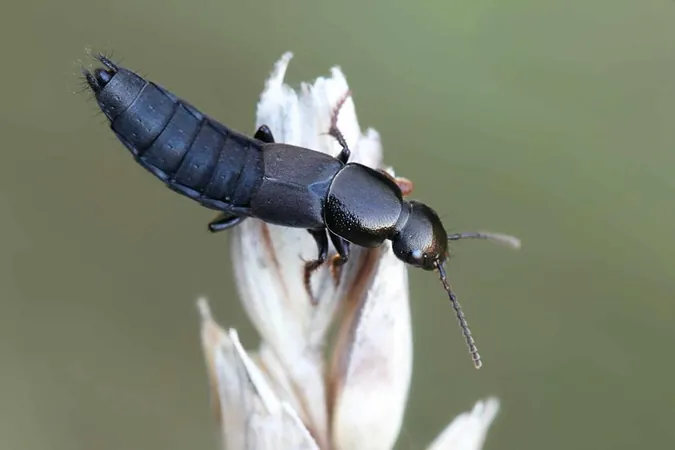
Unveiling the Ancient Secrets of the Rove Beetle: Nature's 100-Million-Year Survivor!
2025-04-18
Author: Chun
A Journey Through Time: The Remarkable Rove Beetle
Insects have long been spinners of survival, with many species dating back hundreds of millions of years. Among them, the astonishing rove beetle (Staphylinidae)—boasting over 66,000 species—has thrived since the time of dinosaurs! These beetles continue to adapt, finding innovative ways to hunt and defend themselves, even evolving traits akin to ants and mites for their survival. What’s the secret behind their astonishing longevity?
The Science Behind Their Survival: A Revolutionary Discovery
Recent research unveiled in the journal *Cell* has peeled back the layers of this mystery. Scientists discovered the twin cell types in the rove beetle's tergal gland, which produces key protective repellents. One cell generates a toxic chemical like benzoquinone, while the other provides an activating liquid. Together, these components create a formidable defense against predators—a strategy that mirrors protective mechanisms found in plant life.
Caltech biologist Joe Parker, a lead author of the study, described the tergal gland as an “incredible, reprogrammable device for making new chemistries.” This evolutionary marvel has allowed rove beetles to explore unique ecological niches, transforming them into masters of adaptation.
Masters of Deception: The Beetles' Survival Tactics
For over 100 million years, rove beetles have fine-tuned their gland chemistry. They don’t just repel threats; they also cleverly mimic prey, earning access into environments like ant colonies through a process called myrmecophily. These beetles can fool ants into believing they belong, all thanks to their specialized glands.
Interestingly, as some species integrate into aggressive ant colonies, they may even evolve to lose their glands altogether, showcasing their incredible adaptability.
Peering into the Beetle's Complex Longevity
To unravel these secrets, scientists analyzed rove beetle genomes, tracing the tergal gland back to its inception during the Early Cretaceous period. They examined the evolution of the two cell types within the gland and their sophisticated chemical defense mechanisms by reprogramming their genetic functions.
This meticulous research highlighted the conserved genetic architecture across diverse rove beetle species, revealing that some ancient genes have adapted to new roles, while others have emerged entirely to bolster their survival strategies.
Nature’s Twin: Rove Beetles and Plant Defenses
Intriguingly, like certain plants, rove beetles can synthesize toxic chemicals that ward off attackers. This ability comes from a series of molecular evolutionary steps converging with plant toxin release systems—demonstrating nature’s remarkable ability to innovate similar solutions across species.
These beetles have harnessed their protective arsenal without self-inflicted harm. Their plant-like toxic abilities not only solidify their survival for millions of years but also fuel their exponential diversification into a staggering 66,000 species!
Conclusion: A Testament to Evolutionary Resilience
The rove beetle’s story is a thrilling testament to evolutionary resilience and adaptability. From their intricate chemical warfare to their skillful manipulation of other species, these insects exemplify the secrets of survival that have stood the test of time. The wonders of nature continue to unfold, leaving us in awe of the relentless march of evolution!

 Brasil (PT)
 Canada (EN)
 Chile (ES)
 Česko (CS)
 대한민국 (KO)
 España (ES)
 France (FR)
 Hong Kong (EN)
 Italia (IT)
 日本 (JA)
 Magyarország (HU)
 Norge (NO)
 Polska (PL)
 Schweiz (DE)
 Singapore (EN)
 Sverige (SV)
 Suomi (FI)
 Türkiye (TR)
 الإمارات العربية المتحدة (AR)