Unveiling the Danger: Cancer-Causing Arsenic Found in Global Rice Supply
2025-04-20
Author: Ken Lee
Cancer Risk Soars as Arsenic Levels Rise in Rice
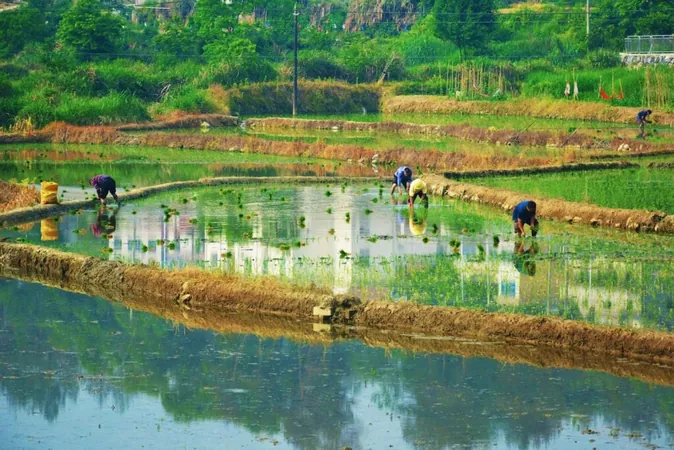
In the lush expanses of the Yangtze River Delta, known for its abundant rice farming, fields bloom with tall green stalks. Yet, a troubling truth lurks beneath the surface: rice is becoming a significant source of inorganic arsenic, and climate change is exacerbating the problem. A groundbreaking study revealed alarming trends that could pose severe health risks to millions who depend on rice as a dietary staple.
Climate Change: A Silent Threat to Our Staple Food
As global temperatures rise, the cultivation methods that have defined rice farming for thousands of years are increasingly under threat. Researchers highlighted that after drinking water, rice represents the second-largest contributor to inorganic arsenic intake worldwide. If current agricultural practices remain unchanged, communities reliant on rice could face elevated cancer and disease risks by 2050.
"Our findings are frightening," stated ecologist Donming Wang, who led the study. "This is a disaster and a wake-up call for global health."
Digging Deeper: The Research That Spans Nearly a Decade
Wang and an international team embarked on a comprehensive research project nearly ten years ago, assessing how future climate scenarios might affect arsenic levels in rice. Their work focused on leading rice-producing nations such as Bangladesh, China, and India, conducting extensive fieldwork across the delta.
Focusing on 28 varieties of rice, the team found that rising temperatures and increased CO2 levels made it easier for plants to absorb arsenic from the soil. The interconnected relationship between climate changes and soil chemistry fosters an alarming environment for arsenic accumulation.
The Alarming Truth About Arsenic
Inorganic arsenic, classified by the World Health Organization as a confirmed carcinogen, poses serious health risks, including various cancers and heart disease. Despite being recognized as a growing concern, dietary exposure has been seen as less hazardous than contaminated water, leading to slow policy action.
Wang's study warns that under a worst-case climate scenario, arsenic levels in rice could skyrocket by 44%. By 2050, over half of the rice samples assessed might exceed safety limits, translating to an estimated 13.4 million new cancer cases linked to arsenic exposure from rice.
Children at Greatest Risk
Infants and young children are disproportionately vulnerable, specifically through rice cereals, which are a common dietary choice. The study underscores the need for urgent intervention as the health implications grow.
The Way Forward: Addressing a Global Threat
Researchers stress that while the presence of arsenic in rice is concerning, completely abandoning rice isn't the solution. For those who consume rice regularly, understanding and mitigating the health risks is critical. Furthermore, socio-economic factors come into play; rice is a staple due to its affordability.
To combat this looming health crisis, experts advocate for sustainable practices like early planting, improved soil management, and innovative breeding techniques to reduce arsenic accumulation. Additionally, water-efficient irrigation methods could significantly decrease both health risks and methane emissions from rice production.
As one expert noted, these changes may not capture headlines like climate disasters, but they are vital to ensuring a healthier future for humanity. The stakes are indeed high, and urgent action is needed to protect one of our most essential food sources.
 Brasil (PT)
 Canada (EN)
 Chile (ES)
 Česko (CS)
 대한민국 (KO)
 España (ES)
 France (FR)
 Hong Kong (EN)
 Italia (IT)
 日本 (JA)
 Magyarország (HU)
 Norge (NO)
 Polska (PL)
 Schweiz (DE)
 Singapore (EN)
 Sverige (SV)
 Suomi (FI)
 Türkiye (TR)
 الإمارات العربية المتحدة (AR)