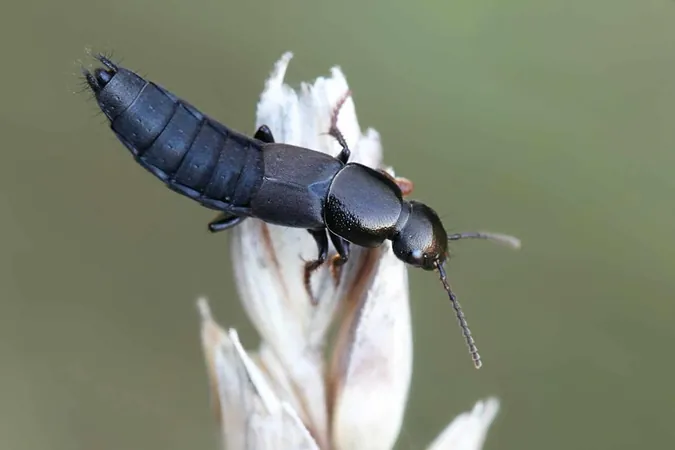
Unveiling the Secrets of the Ancient Rove Beetle: A 100 Million-Year Survival Story!
2025-04-19
Author: Chun
The Incredible Longevity of Rove Beetles
For over 100 million years, rove beetles have witnessed the rise and fall of dinosaurs, thriving through countless epochs. With more than 66,000 species, these little powerhouses have mastered the art of survival by cleverly adapting to their surroundings and outsmarting their prey.
The Secret Weapon: Tergal Glands
So, what’s the secret behind their incredible longevity? New research from Cell reveals that the rove beetle’s tergal gland is a marvel of nature. This gland contains two specialized cell types: one generates a potent toxic chemical while the other produces an activating liquid. Together, they create a repellent cocktail that keeps predators at bay.
As Caltech biologist Joe Parker explains, “The rove beetle tergal gland is an amazing, reprogrammable device that has driven these beetles into unique ecological niches.” This gland is crucial for their survival, allowing them not only to repel threats but also to adapt to and dominate diverse environments.
Masters of Mimicry and Manipulation
Not only do rove beetles fend off attackers, but they can also mimic the scent of prey such as ants and mites. By doing so, they infiltrate ant colonies, convincing their members that they’re one of their own—a clever survival strategy enabled by their unique glands.
Evolution in Action: Adaptation to Ant Clans
Fascinatingly, over time, some rove beetle species living alongside aggressive ant colonies have lost their tergal glands altogether, choosing instead to assimilate into their host environment. Sheila Kitchen, lead author of the study, highlights this transformative adaptation: “Once you’ve cohabitated with an army ant colony long enough, the gland becomes unnecessary.”
Unlocking Evolutionary Mysteries
To range these astonishing discoveries, scientists delved into the genetic blueprints of various beetle species, tracing the tergal gland’s lineage back to the Early Cretaceous period. By reprogramming cell types, they unraveled the complex chemical defenses of the rove beetle, revealing how ancient genes have been repurposed or even evolved into new functions.
Nature’s Chemical Arsenal: Rove Beetles vs. Plants
Interestingly, much like certain plants, rove beetles produce toxic repellents without harming themselves. The study outlines how these insects have developed sophisticated defenses akin to plant toxins, allowing them to guard against predators while remaining unharmed by their own secretions.
This incredible ability to thrive and adapt has led to a staggering diversification into 66,000 species, showcasing not only their evolutionary prowess but also their ongoing adaptability in an ever-changing world.


 Brasil (PT)
 Canada (EN)
 Chile (ES)
 Česko (CS)
 대한민국 (KO)
 España (ES)
 France (FR)
 Hong Kong (EN)
 Italia (IT)
 日本 (JA)
 Magyarország (HU)
 Norge (NO)
 Polska (PL)
 Schweiz (DE)
 Singapore (EN)
 Sverige (SV)
 Suomi (FI)
 Türkiye (TR)
 الإمارات العربية المتحدة (AR)