Unveiling the Sun: World's Largest Solar Telescope Reveals Stunning Images of Giant Sunspot
2025-04-24
Author: Jia
While Earth experiences its own wild weather, a different kind of turbulence looms in space. Known as space weather, this includes the turbulent winds and particles streaming from the sun, which can significantly impact Earth’s infrastructure, disrupting power grids and satellite communications.
To better navigate these cosmic tempests, astronomers are now equipped with the most advanced tool to date: the Daniel K. Inouye Solar Telescope (DKIST). Towering majestically atop Haleakalā in Hawaii, this isn't just any telescope—it's the world's largest dedicated to unraveling the mysteries of the sun.
A Milestone Reached: DKIST's Powerful New Camera Takes Center Stage
After over a decade of hard work, the DKIST team has achieved a remarkable milestone by activating one of its most formidable instruments—the Visible Tunable Filter (VTF). Carrie Black, director of the National Solar Observatory, describes the VTF as the finalized piece of DKIST’s scientific arsenal, a crucial development for solar observance.
"The significance of this technological leap is monumental; one could easily equate the VTF to the heartbeat of the Inouye Solar Telescope, finally alive in its destined role," remarks Matthias Schubert, the project scientist behind this game-changing camera.
Astounding Imagery: A First Glimpse at Sunspots
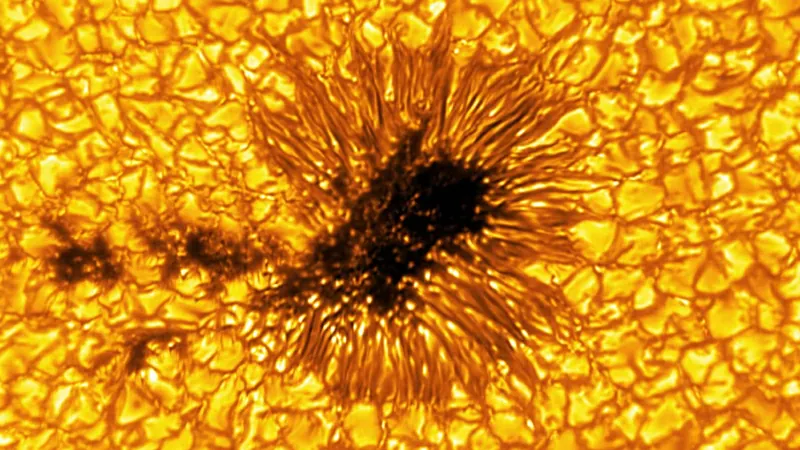
This debut camera shot reveals a colossal cluster of sunspots—dark patches on the sun's surface formed by intense magnetic fields. Each of these sunspots is larger than the United States, showcasing the incredible power and scale of our star. With a remarkable resolution of about 6.2 miles (10 kilometers) per pixel despite the sun being millions of miles away, this new imaging capability is nothing short of revolutionary.
More Than a Snapshot: Understanding Solar Dynamics
The VTF goes beyond capturing mere images; it also gathers crucial spectral data across multiple wavelengths. This sophisticated approach allows scientists to analyze polarization—the orientation of light's electric field—which unveils otherwise hidden details about the sun's surface, magnetic fields, and plasma dynamics, enhancing predictions about solar activity and potential space weather.
In just a single observation, the VTF can collect a staggering 10 million spectra—data graphs that reveal details about the sun’s temperature, magnetic field strength, and much more.
What's Next for the VTF and DKIST?
The groundbreaking developments with the VTF signal the dawn of a new era in solar research. However, the intricate instrument still requires further testing and adjustment, with final tweaks expected to wrap up by next year. Stay tuned—this is just the beginning of unlocking the secrets of our solar system.
 Brasil (PT)
 Canada (EN)
 Chile (ES)
 Česko (CS)
 대한민국 (KO)
 España (ES)
 France (FR)
 Hong Kong (EN)
 Italia (IT)
 日本 (JA)
 Magyarország (HU)
 Norge (NO)
 Polska (PL)
 Schweiz (DE)
 Singapore (EN)
 Sverige (SV)
 Suomi (FI)
 Türkiye (TR)
 الإمارات العربية المتحدة (AR)