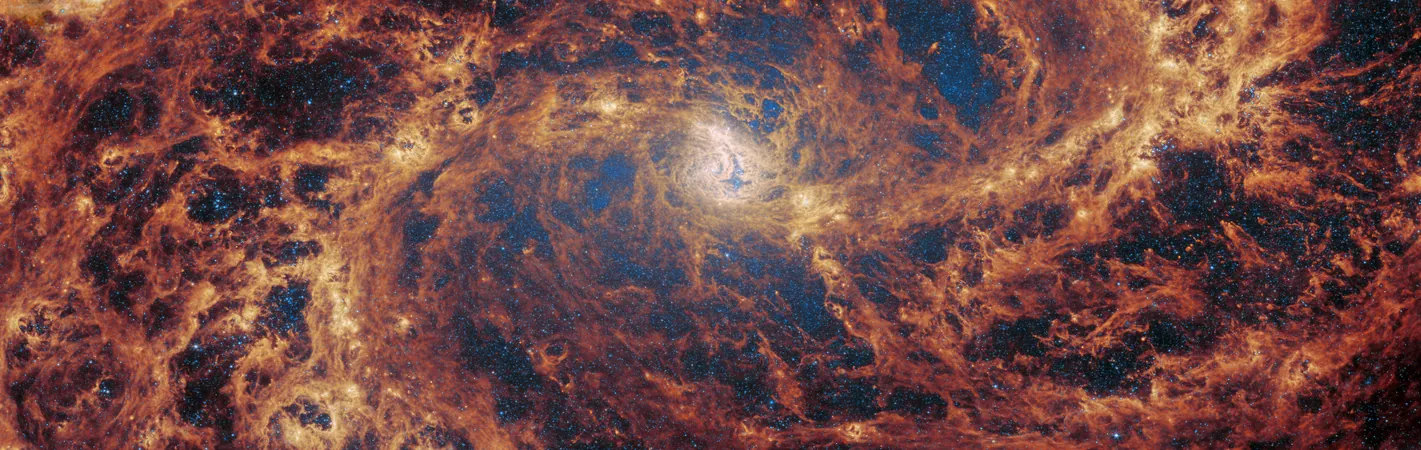
Webb Telescope Uncovers Clues of a Hidden Black Hole in Southern Pinwheel Galaxy M83
2025-04-18
Author: Jessica Wong
Revealing the Mysteries of M83
The Southern Pinwheel Galaxy, or M83, has intrigued astronomers for years. While massive spiral galaxies typically host Active Galactic Nuclei (AGNs), confirming one in M83 has proven elusive. Previous findings hinted that if a supermassive black hole resided there, it was either dormant or concealed by thick dust. However, the James Webb Space Telescope (JWST) has now provided groundbreaking evidence suggesting otherwise.
A Shocking Discovery
Lead researcher Svea Hernandez from the European Space Agency's AURA team expressed astonishment at their findings. "Our discovery of highly ionised neon emissions in M83's nucleus was unexpected. The energy required for these emissions is far beyond what typical stars can produce, indicating a likely AGN presence that has remained hidden until now," she elaborated.
Webb's Game-Changing Technology
Thanks to Webb's unparalleled mid-infrared capabilities, astronomers could peer through the galaxy’s dust and identify minute clumps of highly ionised gas around M83’s core. The energy conditions needed for these findings suggest an AGN is the most plausible explanation, though researchers are also examining other possibilities, such as intense shock waves in the interstellar medium.
Redefining Galaxy Understanding
Co-author Linda Smith from the Space Telescope Science Institute highlighted Webb's revolutionary impact on our understanding of galaxies: "For years, astronomers have searched for a black hole in M83 without success. Now, we finally have a compelling clue suggesting one may indeed exist."
A New Era of Discovery
Smith added, "This discovery illustrates how Webb is ushering in unexpected breakthroughs. Astronomers believed they had ruled out an AGN in M83, but new evidence now challenges that assumption and opens fresh avenues for exploration."
Looking Ahead: Future Studies
The research team plans to conduct follow-up observations using advanced facilities like the Atacama Large Millimeter/submillimeter Array (ALMA) and the Very Large Telescope (VLT). These additional studies aim to definitively ascertain whether the newly detected emissions come from an AGN or if alternative high-energy mechanisms are involved.
Unlocking Cosmic Secrets
This groundbreaking study showcases Webb’s remarkable ability to unveil hidden structures within galaxies, paving the way for new revelations in black hole astrophysics. As astronomers continue to extend the limits of Webb’s capabilities, some of the Universe's most elusive mysteries are coming into clearer focus, promising a thrilling journey ahead.



 Brasil (PT)
 Canada (EN)
 Chile (ES)
 Česko (CS)
 대한민국 (KO)
 España (ES)
 France (FR)
 Hong Kong (EN)
 Italia (IT)
 日本 (JA)
 Magyarország (HU)
 Norge (NO)
 Polska (PL)
 Schweiz (DE)
 Singapore (EN)
 Sverige (SV)
 Suomi (FI)
 Türkiye (TR)
 الإمارات العربية المتحدة (AR)