Why Your Brain is More Than Just a Fancy Computer: The Secrets of Human Intelligence Revealed!
2025-04-25
Author: Ling
The Unique Evolution of the Human Brain
Have you ever wondered why humans think differently from machines? Our brains have evolved through millions of years of dynamic interaction with the world, influencing our perception and understanding of reality. Yet, recent advances in artificial intelligence (AI) showcase a troubling trend: viewing our brains simply as networks of identical brain cells, or neurons, that merely transmit information.
Rethinking Neural Networks
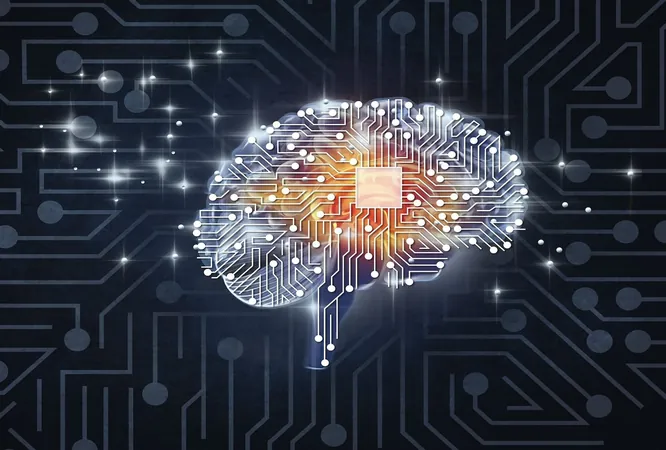
The popular notion of the brain being akin to a neural network resembles existing AI models, where neurons are treated as interchangeable nodes. This perspective, born from computer science, overlooks the incredible diversity and specialization found within human neurons. Each type of neuron serves distinct functions, making the brain itself a marvel of evolutionary adaptation, unlike any machine.
Introducing the New Era of Neural Science
In recent studies, scientists have identified various specialized neurons that challenge the conventional view of the brain as just a highly efficient computer. In fact, the human brain hosts potentially millions of distinct neuron types, which help us encode and represent complex concepts and experiences in ways that simple neural networks cannot.
AI Models: Close Yet So Far
Despite AI's successes in fields like medicine and creative industries, it often misses the subtlety of human intelligence. Experts argue that AI's pattern-learning algorithms can't replicate the nuanced functioning of our specialized neurons. As Jay McClelland, a cognitive scientist at Stanford University, reveals, AI may be missing essential components that characterize human cognition.
Understanding Neurons: The Building Blocks of Thought
Neurons don't simply 'fire'; they encode entire concepts. For example, some neurons activate only in response to specific memories, demonstrating how our brains can recall complex scenes without needing visual stimuli. Notably, research has shown that particular neurons respond uniquely to concepts like iconic TV shows, activating during recall regardless of what is presented on screen.
The Learning Divide: Humans vs. AI
The processes by which we learn and form memories differ significantly from AI’s capabilities. While current AI models often operate on large datasets to improve their outputs, human brains utilize a more efficient method called Behavioral Time Scale Synaptic Plasticity (BTSP). This allows our brains to learn with far fewer repetitions, proving that our intelligence is not merely a matter of firing neurons.
A Brain Unlike Any Other
Our brains, shaped by evolution, allow us to encode rich memories and imaginations that go beyond raw data patterns, positioning us far above current AI systems. This adaptability is crucial; our brain's ability to assemble episodic memories from core semantic facts allows for a depth of understanding that's simply unattainable for machines.
Embracing Human Complexity
While AI continues to evolve, it’s essential that researchers explore the rich tapestry of human neuronal structures. Our unique capabilities allow us to engage with the world meaningfully—including culture and language—which amplifies our cognitive functions in ways that machines can only dream of. As we delve further into brain science, it’s crucial for AI developers to consider these nuances to better emulate authentic human intelligence.
Conclusion: The Future of AI and Human Intelligence
As we navigate the incredible advancements in artificial intelligence, it's clear that the key to replicating human intelligence lies within the specialized adaptations of our neurons. Instead of merely modeling AI on brain functions, a deeper understanding of what makes our brains unique will pave the way for more sophisticated AI systems that might one day bridge the gap between human and artificial cognition.

 Brasil (PT)
 Canada (EN)
 Chile (ES)
 Česko (CS)
 대한민국 (KO)
 España (ES)
 France (FR)
 Hong Kong (EN)
 Italia (IT)
 日本 (JA)
 Magyarország (HU)
 Norge (NO)
 Polska (PL)
 Schweiz (DE)
 Singapore (EN)
 Sverige (SV)
 Suomi (FI)
 Türkiye (TR)
 الإمارات العربية المتحدة (AR)