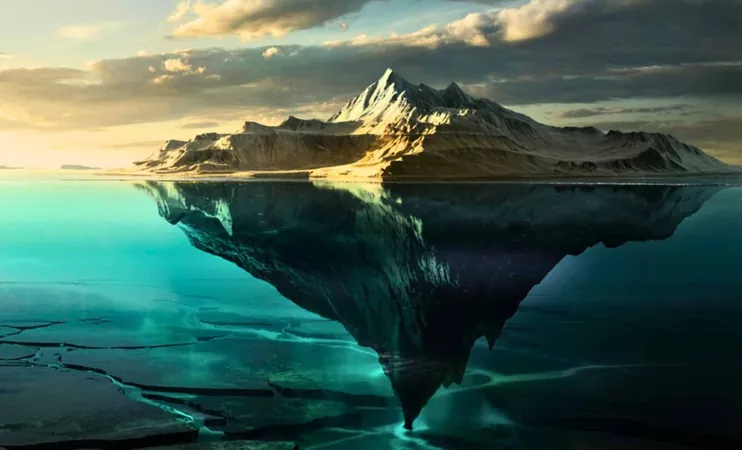
A Hidden Continent Emerges: Geologists Discover Microcontinent Beneath Greenland's Ice
2025-04-18
Author: Wei Ling
In a groundbreaking discovery, geologists have unveiled a long-lost continental fragment hidden beneath Greenland's thick ice. This microcontinent, a remnant of ancient geological forces, was formed millions of years ago and lies at the heart of a complex tectonic rift system straddling Greenland and Canada.
Redefining the Geological Map of the North Atlantic
The revelation of this microcontinent not only reshapes our understanding of the North Atlantic's geological landscape, but also sheds light on critical processes such as plate tectonics and continental separation. It reveals how ancient crustal fragments end up stranded during the formation of new oceanic regions.
The Rifting Forces at Play
The area between Greenland and Canada has fascinated scientists due to its intricate geological history. The Davis Strait connects Baffin Bay and the Labrador Sea, regions molded by tectonic activity during the Paleogene period, roughly 61 to 33 million years ago. This era marked the beginning of significant rifting and seafloor spreading as Earth's crust began to fracture.
Researchers now propose that a section of this continental crust, between 19 and 24 kilometers deep, was left partially intact during the rifting phase, ultimately becoming trapped beneath the ocean floor.
Unveiling the Davis Strait Proto-Microcontinent
Dubbed the Davis Strait proto-microcontinent, this geological block represents a slab of continental lithosphere that remains partially connected but not entirely attached to a main landmass.
Advanced Techniques Reveal Tectonic Secrets
Cutting-edge gravity mapping and seismic imaging techniques allowed scientists to decipher the intricacies of the region's structure and fault lines. Their findings indicated a significant shift in seafloor spreading direction that occurred between 49 and 58 million years ago. This change from a northeast-southwest to a north-south orientation was pivotal in separating the Davis Strait microcontinent.
By around 33 million years ago, the geological activity subsided, resulting in Greenland merging with Ellesmere Island, forming part of the North American plate. From then on, the proto-microcontinent was locked in its subterranean position along Greenland’s western coastline.
Unraveling Earth's Geological Mysteries
According to the research team, including Dr. Jordan Phethean from the University of Derby, and Dr. Christian Schiffer from Uppsala University, the unique tectonic history of this area offers invaluable insights into the formation of microcontinents. Their study in Gondwana Research suggests that these structures are not merely geological anomalies; they are crucial to understanding the dynamics of Earth's crust over time.
Dr. Phethean asserts that rifting and microcontinent formation are ongoing processes, hinting that each earthquake could inch us closer to discovering the next microcontinent.
Tying into a Global Geological Narrative
The Davis Strait finding fits into a broader landscape of similar submerged microcontinents around the world. Places like Jan Mayen near Iceland, the East Tasman Rise, and the Gulden Draak Knoll could have formed through analogous tectonic shifts and partial rifting.
As scientists explore these models further, the discovery beneath Greenland transforms from a mere local curiosity to a key piece of the puzzle in understanding the ongoing evolution of our planet's surface.
 Brasil (PT)
 Canada (EN)
 Chile (ES)
 Česko (CS)
 대한민국 (KO)
 España (ES)
 France (FR)
 Hong Kong (EN)
 Italia (IT)
 日本 (JA)
 Magyarország (HU)
 Norge (NO)
 Polska (PL)
 Schweiz (DE)
 Singapore (EN)
 Sverige (SV)
 Suomi (FI)
 Türkiye (TR)
 الإمارات العربية المتحدة (AR)