A New Threat: The Rise of Plasmodium Cynomolgi and Its Zoonotic Malaria Risks in Southeast Asia
2025-04-23
Author: Jia
Unveiling a Growing Health Risk in Southeast Asia
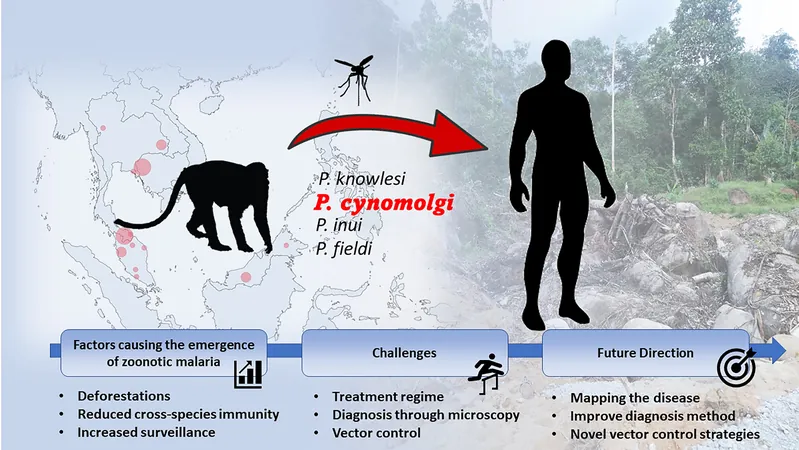
Southeast Asia is facing an alarming rise in zoonotic malaria cases, primarily due to the emergence of *Plasmodium cynomolgi*. This parasite, which primarily infects macaques, has the potential to cross over to humans, complicating efforts to eliminate malaria in the region.
The Perfect Storm: Habitat Loss and Disease Transmission
In recent decades, the habitats of both humans and non-human primates (NHPs) like macaques have increasingly overlapped due to urbanization and deforestation. This overlap has created a conducive environment for malaria transmission. As macaques venture closer to human settlements in search of food, the risks associated with zoonotic malaria infections, particularly from *P. cynomolgi*, rise.
The Surprising Potential of *P. Cynomolgi* in Humans
*P. cynomolgi* isn't just another parasite lurking in the wild; it was the first NHP malaria strain to infect humans in laboratory settings. While the majority of recorded cases remain infrequent, the rising numbers call for urgent attention. Substantial research indicates that *P. cynomolgi* can adapt to human physiology, raising concerns about its capacity to cause outbreaks among human populations.
Understanding the Vector Dynamics
The primary carriers of *P. cynomolgi* are mosquitoes, particularly from the Anopheles Leucosphyrus Group, known for their effectiveness in transmitting malaria. Blood meal analyses have confirmed that these mosquitoes frequently feed on both humans and monkeys, heightening the risk of zoonotic transmission.
The Alarming Asymptomatic Nature of Infections
Interestingly, many infections in humans may be asymptomatic. Studies have shown that small sub-microscopic parasitemia can complicate detection. The parasite may hide in the body, leading to mild symptoms that often go unnoticed. This characteristic presents a significant challenge in identifying and managing potential cases.
The Impacts of Declining Immunity
As human cases of common malaria types, including *Plasmodium vivax*, have declined, overall immunity in populations may weaken. This decline opens the door for *P. cynomolgi* to take root, highlighting the need for continuous monitoring and research.
 Brasil (PT)
 Canada (EN)
 Chile (ES)
 Česko (CS)
 대한민국 (KO)
 España (ES)
 France (FR)
 Hong Kong (EN)
 Italia (IT)
 日本 (JA)
 Magyarország (HU)
 Norge (NO)
 Polska (PL)
 Schweiz (DE)
 Singapore (EN)
 Sverige (SV)
 Suomi (FI)
 Türkiye (TR)
 الإمارات العربية المتحدة (AR)