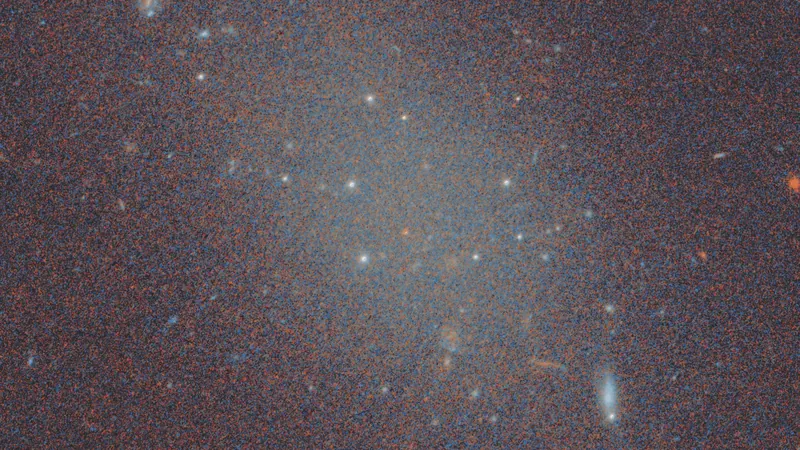
Astronomers Stumble Upon Mysterious Dark Matter-Free Galaxy
2025-04-18
Author: Daniel
A Cosmic Puzzle: The Case of the Ghostly Galaxy
In a groundbreaking discovery, astronomers have identified yet another ghostly galaxy that seems utterly devoid of dark matter, the elusive substance thought to dominate the universe and shape galaxies.
Finding a galaxy that doesn’t harbor dark matter is akin to encountering a shadow without a light source—perplexing and intriguing. This fascinating phenomenon primarily involves what are known as 'ultradiffuse galaxies,' which boast a vast size comparable to our Milky Way but are astonishingly sparse in stellar content.
Meet FCC 224: A Galaxy Unlike Any Other
The latest addition to this cryptic group is FCC 224, found on the outskirts of the Fornax Cluster, approximately 65 million light-years from our planet. First detected in 2024, this dwarf galaxy features around a dozen tightly bound clusters of stars—an unusually rich assembly atypical for its size and apparent lack of dark matter.
Distinctly different from other dark matter-deficient galaxies, FCC 224 may signify a previously unknown class of dwarf galaxies, according to two recent studies that have sent shockwaves through the astronomical community.
Why Does It Matter?
Maria Buzzo, a doctoral candidate in astrophysics at Swinburne University, emphasized the significance of this discovery, stating, "No existing galaxy formation model can currently explain how this galaxy came to be." Her team utilized data from the renowned Keck Observatory in Hawaii, revealing that the star clusters within FCC 224 move at a sluggish pace—pointing to a lack of the strong gravitational pull typically associated with dark matter.
Researchers face an intriguing dilemma: what exactly caused FCC 224 to form in this manner?
A Cosmic Collision?
One theory proposed by astronomer Yimeng Tang from the University of California, Santa Cruz, suggests that FCC 224 could have emerged from a high-energy collision of gas-rich galaxies. This violent encounter may have led to the separation of gas from dark matter, resulting in the birth of one or more galaxies devoid of the mysterious substance.
According to previous findings, other galaxies like DF2 and DF4 from the NGC 1052 group exhibit similar dark matter deficiencies, originating from the same ancient cosmic collision. Excitingly, Tang’s team hints that FCC 224 might also have a twin, suspected to be the nearby galaxy FCC 240, which mirrors its size and shape.
A Chaotic Formation?
Alternatively, another theory proposes that FCC 224 may have formed in a chaotic, high-energy environment where intense star formation expelled dark matter due to massive star clusters. No matter the cause, each new piece of evidence offers tantalizing insights into the complexities of dark matter in the cosmic landscape.
Unlocking the Secrets of the Universe
Buzzo concluded, "FCC 224 serves as a crucial data point in our efforts to identify and study other dark-matter-deficient galaxies. By broadening our sample size, we can deepen our understanding of these rare galaxies and the influential role of dark matter in dwarf galaxy formation." This discovery adds yet another layer to the ongoing exploration of our universe, beckoning further research into the mysteries that lie beyond our cosmic horizon.

 Brasil (PT)
 Canada (EN)
 Chile (ES)
 Česko (CS)
 대한민국 (KO)
 España (ES)
 France (FR)
 Hong Kong (EN)
 Italia (IT)
 日本 (JA)
 Magyarország (HU)
 Norge (NO)
 Polska (PL)
 Schweiz (DE)
 Singapore (EN)
 Sverige (SV)
 Suomi (FI)
 Türkiye (TR)
 الإمارات العربية المتحدة (AR)