Astronomers Unveil 15 New Giant Radio Galaxies: A Cosmic Breakthrough!
2025-04-24
Author: Wei Ling
A Stunning Discovery in the Cosmos
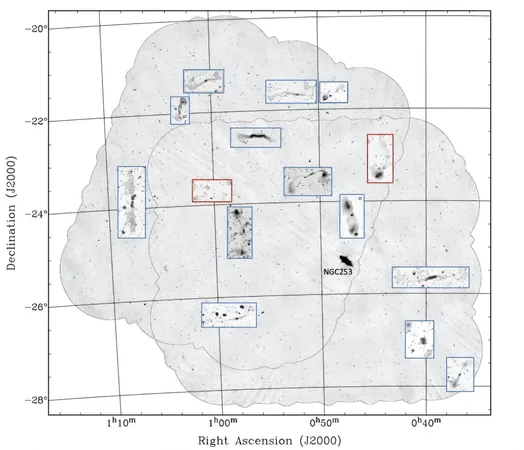
In an exciting new development, astronomers using the Australian Square Kilometer Array Pathfinder (ASKAP) have unveiled a remarkable 15 giant radio galaxies (GRGs), each boasting sizes greater than 3 million light years!
What Are Giant Radio Galaxies?
Known for their massive dimensions, these GRGs stretch over 2.3 million light years and are fascinating phenomena formed in low-density environments. They exhibit powerful jets and lobes composed of synchrotron-emitting plasma, providing crucial insights into the formation and evolution of radio sources.
ASKAP: A Cutting-Edge Tool for Discovery
ASKAP, a state-of-the-art 36-dish radio-interferometer, operates within a frequency range of 700 to 1,800 MHz. Thanks to its innovative technology, it achieves lightning-fast survey speeds, making it a premier instrument for mapping the sky in radio wavelengths. Its vast field of view and excellent sensitivity to low-surface brightness structures have been pivotal in the exciting search for new GRGs.
From the Lab: Preliminary Findings
Leading the charge is a team from Western Sydney University, headed by Baerbel Silvia Koribalski. In their recent research, they reported on the discovery of these remarkable cosmic entities during wide-field observations at 944 MHz.
The newly identified GRGs have projected linear sizes ranging from 3.7 to a staggering 12.36 million light years, with redshifts between 0.056 and 0.735. Among these, ASKAP J0044−2317 and ASKAP J0059−2352 are candidates still needing verification for their GRG status.
Diverse Morphologies Uncovered!
What makes this discovery even more intriguing is the variety of morphologies among the newly detected galaxies. Eight of them belong to the Fanaroff-Riley Class II (FR II) category, characterized by striking radio hot spots at their lobes’ ends. Conversely, four are classified as Fanaroff-Riley Class I (FR I) galaxies, showcasing bright inner jets but fading outer lobes. The remaining three galaxies present as hybrid FR I/II types.
Spotlight on the Largest GRG Ever!
Taking center stage is the colossal ASKAP J0107−2347 at a redshift of 0.31, a double-double radio galaxy (DDRG) of the FR II type! It features two distinct sets of lobes, with newly formed inner lobes stretching over 2 million light years, showcasing a dazzling brightness. Meanwhile, its outer lobes are elongated and display a very low surface brightness.
This groundbreaking discovery paves the way for further research into the mysterious world of giant radio galaxies, offering astronomers a treasure trove of data to unravel the secrets of our universe.
 Brasil (PT)
 Canada (EN)
 Chile (ES)
 Česko (CS)
 대한민국 (KO)
 España (ES)
 France (FR)
 Hong Kong (EN)
 Italia (IT)
 日本 (JA)
 Magyarország (HU)
 Norge (NO)
 Polska (PL)
 Schweiz (DE)
 Singapore (EN)
 Sverige (SV)
 Suomi (FI)
 Türkiye (TR)
 الإمارات العربية المتحدة (AR)