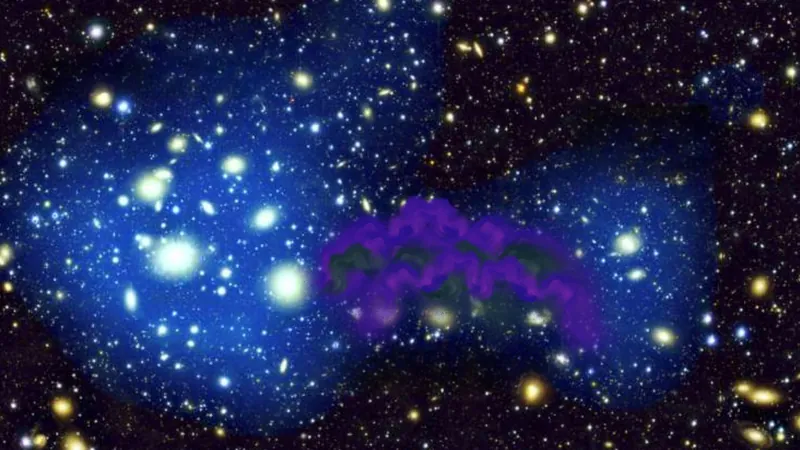
Astronomers Unveil Dark Matter 'Bridge' Connecting Colliding Galaxies: A Groundbreaking Discovery!
2025-04-23
Author: Wei Ling
Astronomers have made an astonishing breakthrough, revealing a long-sought-after element in the cosmic clash of the Perseus galaxy cluster, located a staggering 240 million light-years away from Earth.
This extraordinary finding includes a newly identified "subcluster," positioned 1.4 million light-years west of NGC 1275, the Perseus cluster’s central galaxy. Remarkably, these cosmic titans are interconnected by a delicate "bridge" of material.
At the heart of this bridge is dark matter, the universe’s enigmatic substance that eludes direct observation. Though invisible to the naked eye, dark matter's gravitational effects play a crucial role in the formation and stability of galaxies.
Team member James Jee expressed excitement about the discovery, stating, "This is the missing piece we've been looking for. All the odd shapes and swirling gas observed in the Perseus cluster now make sense in the context of a major merger."
Galaxies Colliding: Unraveling the Mysteries of the Universe
Galaxy clusters, which are colossal structures comprising thousands of galaxies held together by gravity, represent some of the largest formations in the universe. Scientists have theorized that their growth often results from high-energy mergers—explosive events that rival the power of the Big Bang.
The Perseus cluster, weighing in at approximately 600 trillion solar masses, has long enjoyed its status as the "poster child" for galaxy clusters. Yet, until this groundbreaking revelation, it lacked clear evidence of growth through mergers.
New data gathered using the Subaru Telescope, equipped with the advanced Hyper Suprime-Cam, has allowed researchers to probe deeper into the cluster than ever before.
The Power of Gravitational Lensing: A Gateway to Discovery
The investigation employed an innovative technique known as "gravitational lensing," first anticipated by Albert Einstein in his 1915 theory of general relativity. This phenomenon occurs when massive objects distort the very fabric of spacetime, causing light from distant objects to bend and amplify.
Through this lensing effect, astronomers uncovered a massive clump of dark matter within the Perseus cluster, weighing an astonishing 200 trillion solar masses. This clump is intricately connected to the cluster’s core by a tapered dark matter bridge.
Computer simulations point to a cosmic collision that occurred around 5 billion years ago, with the remnants of this event still influencing the structure of the Perseus cluster today.
"This breakthrough demonstrates the power of combining deep imaging data with advanced gravitational lensing techniques to reveal the hidden dynamics of the universe's most massive structures," Jee concluded, paving the way for exciting new explorations in astrophysics.
 Brasil (PT)
 Canada (EN)
 Chile (ES)
 Česko (CS)
 대한민국 (KO)
 España (ES)
 France (FR)
 Hong Kong (EN)
 Italia (IT)
 日本 (JA)
 Magyarország (HU)
 Norge (NO)
 Polska (PL)
 Schweiz (DE)
 Singapore (EN)
 Sverige (SV)
 Suomi (FI)
 Türkiye (TR)
 الإمارات العربية المتحدة (AR)