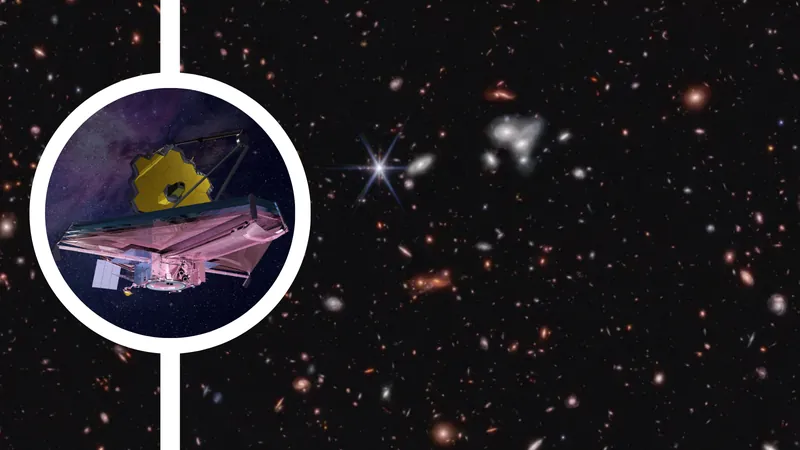
Black Holes on the Rise! James Webb Space Telescope Reveals Cosmic Secrets from 'Cosmic Noon'
2025-04-24
Author: John Tan
A Spectacular Journey Back in Time
Get ready to be amazed! Astronomers utilizing the James Webb Space Telescope (JWST) have transported us over 10 billion years into the past to uncover thrilling discoveries from a pivotal era of the universe. This groundbreaking research from the University of Kansas has revealed that during a fascinating epoch known as "cosmic noon," black holes at the cores of ancient galaxies were experiencing explosive growth.
What is Cosmic Noon?
Cosmic noon is a tantalizing and enigmatic phase of the universe's evolution, roughly 2 to 3 billion years following the Big Bang. During this dynamic period, galaxies similar to our Milky Way were in the throes of a spectacular star-formation frenzy termed "starburst." The stellar activity was so intense that the researchers believe this era is responsible for birthing half the stars we observe in contemporary galaxies.
Surveying the Stars Like Never Before
The KU team initiated the MIRI EGS Galaxy and AGN (MEGA) survey using the JWST to delve into this critical segment of the universe's 13.8-billion-year saga. "Our mission is to unravel the mysteries of galaxy formation, the stellar births occurring, and particularly how the supermassive black holes at their centers are evolving," said principal investigator Allison Kirkpatrick.
Dancing with Dust: JWST's Unique Advantage
These galaxies are obscured by thick clouds of dust that efficiently absorb visible light, presenting a challenge for astronomers. Fortunately, JWST excels at detecting infrared light, allowing scientists to penetrate these dusty veils and unlock the secrets hidden within.
Exploring the Extended Groth Strip
The team turned their gaze to an exciting region of sky, dubbed the Extended Groth Strip, located in the constellation Ursa Major. Kirkpatrick described it as one of the premier JWST fields, revealing around 10,000 galaxies within an area barely wider than the moon!
Hunting for Supermassive Black Holes
The researchers sought galaxies housing voracious supermassive black holes. While black holes don’t emit light, the swirling material around them radiates brightly as it heats up—a phenomenon known as active galactic nuclei (AGN). The galaxies observed in the MEGA study may be the ancestors of Milky Way-type galaxies, offering a chance to glean insights about our own galaxy’s early days.
Behind the Scenes: Processing Cosmic Data
Processing the immense data collected was no small task, and there’s even a chance for you to get involved! Researchers like KU's Bren Backhaus are meticulously refining the raw images captured by JWST. "It’s a bit like taking photos through colored filters; each image reveals a unique aspect of the galaxy," he explained.
Your Chance to Get Involved!
With 67 hours of JWST observation completed and an additional 30 hours approved, the KU team is sitting on a treasure trove of data. Though the larger scientific community will eventually gain access, KU students are currently the exclusive beneficiaries. However, you can still contribute to astronomical discoveries through the Cosmic Collisions Zooniverse project, where the public can help classify galaxies and identify cosmic collisions.
What’s Next?
As researchers continue to sift through the data, the potential to understand our universe better is immense. This project not only pushes the boundaries of astronomical science but also invites everyone to participate in the exploration of the cosmos!
 Brasil (PT)
 Canada (EN)
 Chile (ES)
 Česko (CS)
 대한민국 (KO)
 España (ES)
 France (FR)
 Hong Kong (EN)
 Italia (IT)
 日本 (JA)
 Magyarország (HU)
 Norge (NO)
 Polska (PL)
 Schweiz (DE)
 Singapore (EN)
 Sverige (SV)
 Suomi (FI)
 Türkiye (TR)
 الإمارات العربية المتحدة (AR)