Breakthrough Discovery: James Webb Telescope Reveals Intriguing Signs of Alien Atmosphere!
2025-04-24
Author: Yu
Breaking News from the Cosmos!
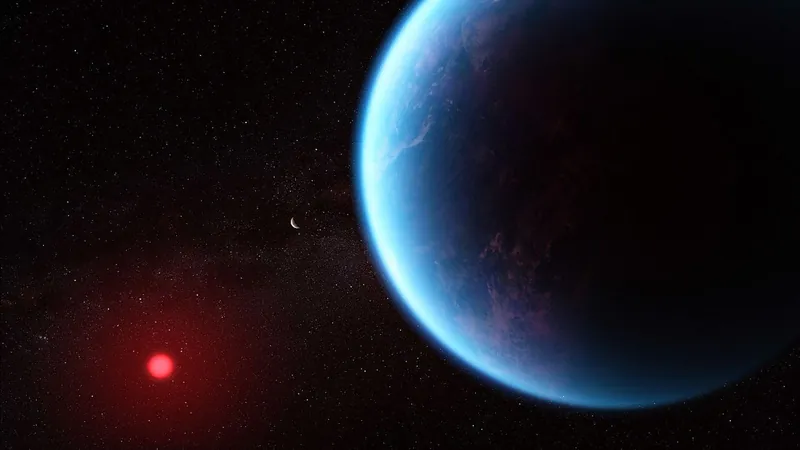
The James Webb Space Telescope (JWST) has unveiled an extraordinary breakthrough in the quest to understand exoplanet atmospheres, delivering the most detailed analysis yet of a distant world beyond our Solar System—K2-18b!
Unveiling K2-18b's Secrets
Situated approximately 120 light-years away, K2-18b orbits a cooler, smaller red dwarf star. Excitingly, researchers have tentatively identified two intriguing chemical compounds: dimethyl sulfide (DMS) and dimethyl disulfide (DMDS). While these compounds are typically associated with biological processes here on Earth, they also exist elsewhere in the universe, raising questions about possible life.
A Collaborative Scientific Triumph
Led by Nikku Madhusudhan, an astrophysics professor at the University of Cambridge, a team of international researchers harnessed the JWST's capabilities to dissect the atmosphere of K2-18b. The findings have sparked considerable media interest, particularly regarding their implications for extraterrestrial life. However, those conclusions come with a hefty dose of caution.
Cautions on the Findings
Currently, there's only a 99.7% chance that DMS and DMDS were detected, but this high likelihood doesn’t eliminate alternative explanations. Further observations will be crucial to solidify these findings. The initial sensational headlines might have overreached, as the possibility of life remains unconfirmed.
From Kepler to JWST: The Journey Continues
K2-18b was first spotted by the Kepler mission in 2015. Its unique characteristics—8.6 times the mass of Earth and 2.6 times its radius—marked it for further investigation. Previous studies using the Hubble Space Telescope suggested the existence of water vapor or methane in its atmosphere, but the data weren’t definitive. Thanks to the JWST's superior capabilities, stronger evidence for methane has emerged.
The Hycean World Hypothesis
Though not yet classified as a confirmed hycean planet, K2-18b represents a new category of celestial bodies theorized to have immense liquid water oceans beneath a hydrogen-rich atmosphere. The JWST's findings could influence our understanding of these fascinating worlds.
Technological Marvel of the JWST
The JWST's capability to sift through the light from K2-18b’s parent star—despite the turbulent nature of red dwarf stars—underscores a monumental achievement in space science. Its success affirms the dedication and countless efforts behind its development, showcasing the heights humanity can reach through scientific inquiry.
A Call to Action: Science Needs Support
Despite the awe-inspiring scientific progress, there are concerning budget cuts looming for NASA, which could endanger future discoveries. While some powers wish to stifle scientific advancement, it's clear that the public yearns for knowledge and exploration. Our journey into the stars continues, but it requires unwavering support and commitment!
Join the Journey!
As we further explore the cosmos, the potential for new discoveries beckons. The quest for understanding K2-18b may just be the beginning of unraveling the mysteries of life beyond Earth!
 Brasil (PT)
 Canada (EN)
 Chile (ES)
 Česko (CS)
 대한민국 (KO)
 España (ES)
 France (FR)
 Hong Kong (EN)
 Italia (IT)
 日本 (JA)
 Magyarország (HU)
 Norge (NO)
 Polska (PL)
 Schweiz (DE)
 Singapore (EN)
 Sverige (SV)
 Suomi (FI)
 Türkiye (TR)
 الإمارات العربية المتحدة (AR)