Breakthrough in Hepatitis D Research: Stem Cell Model Reveals New Viral Weakness
2025-04-23
Author: Nur
A revolutionary stem cell-based infection model has emerged, offering a beacon of hope in the fight against the elusive Hepatitis D virus (HDV), which wreaks havoc on the liver and causes severe inflammation. According to the World Health Organization, a staggering 12 million people globally are living with HDV, and current treatment options remain limited.
Researchers at TWINCORE in Hannover have unveiled their groundbreaking model, shedding light on potential strategies to combat this devastating virus. Their findings were recently published in the prestigious journal, JHEP Reports.
What Makes HDV Such a Nemesis?
Hepatitis D is classed as a satellite virus due to its dependence on Hepatitis B virus (HBV) for survival. Remarkably, it carries a minimal genetic blueprint, producing just one protein and relying entirely on HBV for its viral envelope. Interestingly, the Hepatitis B vaccine offers protection against HDV, but the latter remains notorious for causing the most severe form of viral hepatitis.
The Hunt for New Treatments
Although existing therapies such as interferon-alpha and the new drug Hepcludex—designed to block HDV's entry into liver cells—are available, they have significant limitations. Hepcludex does not possess direct antiviral properties and fails to prevent the replication of virus-laden daughter cells during cell division. This gap has ignited a quest for additional antiviral agents to enhance treatment protocols.
Innovative Insights from a Stem Cell Model
Dr. Arnaud Carpentier, a postdoctoral researcher and expert in stem cell models, is at the forefront of this innovative research. "Our stem cell-based culture system closely mimics primary liver cells, providing more accurate conditions compared to traditional liver cell lines used in hepatitis studies," says Carpentier.
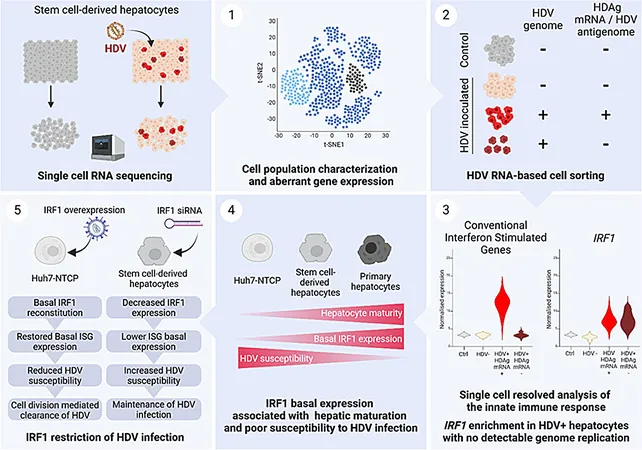
To dissect the intricate processes of HDV infection, Carpentier's team utilized single-cell sequencing to analyze gene activity in infected cells. Their findings showed a striking division among the infected cells: while some actively replicated the virus, others remained dormant.
The Role of IRF1: A Potential Game Changer
Central to their discoveries is the gene IRF1, which stands for Interferon Regulatory Factor 1. This transcription factor is crucial for cellular immune responses. "Data indicates that increased IRF1 expression can inhibit HDV infection and cut off the virus's spread during cell division—a pathway overlooked by Hepcludex," explains Frauke Lange, a doctoral student and lead author of the study.
IRF1 influences the activity of 101 downstream genes, and Lange’s team is now set to explore these genetic pathways to identify which ones might hold the key to effective antiviral interventions against HDV.
A Future Full of Promise
The research paves the way for developing next-generation treatments for HDV, promising a new era of combination therapies alongside existing options like Hepcludex. With this novel insight into the virus’s mechanisms, the scientific community is one step closer to turning the tide on Hepatitis D.
 Brasil (PT)
 Canada (EN)
 Chile (ES)
 Česko (CS)
 대한민국 (KO)
 España (ES)
 France (FR)
 Hong Kong (EN)
 Italia (IT)
 日本 (JA)
 Magyarország (HU)
 Norge (NO)
 Polska (PL)
 Schweiz (DE)
 Singapore (EN)
 Sverige (SV)
 Suomi (FI)
 Türkiye (TR)
 الإمارات العربية المتحدة (AR)