Breakthrough in Infrared Technology: New Crystals Set to Revolutionize Optical Applications!
2025-03-25
Author: Mei
Breakthrough in Infrared Technology: New Crystals Set to Revolutionize Optical Applications!
Long-wave infrared birefringent crystals are becoming critical in advancing infrared optical applications, ranging from sophisticated imaging technology and laser systems to cutting-edge optical communications. However, the quest for high-performance crystals has faced significant hurdles, primarily due to limitations in birefringence, infrared transmission, and the complexities of crystal growth. Until now, high-quality long-wave infrared birefringent crystals were rare.
Exciting developments have emerged from a research team led by Prof. Kong Fang at the Fujian Institute of Research on the Structure of Matter, part of the prestigious Chinese Academy of Sciences. Their latest study, featured in the renowned journal Angewandte Chemie International Edition, introduces an innovative approach to synthesizing these crucial crystals through a novel oxygenation strategy.
Traditionally, metal halides with lone-pair electrons were viewed as potential candidates for long-wave infrared birefringent materials. Nonetheless, the "holodirected" coordination of metal ions, especially when combined with heavy halogens, significantly diminished the effectiveness of these lone-pair electrons, thereby constraining the birefringence capabilities of such structures.
The groundbreaking oxygenation strategy proposed by the research team allows for the substitution of the monovalent halide ion within the halogen polyhedron with a divalent oxygen ion. This strategic swap activates the lone-pair electrons associated with central cations, ultimately enhancing the birefringence of the resulting crystals.
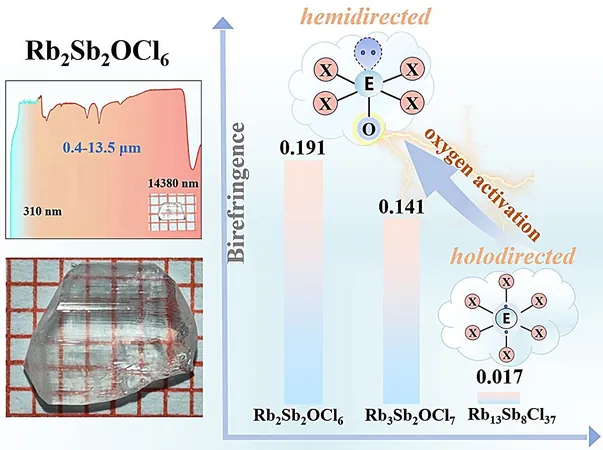
Through their experiments, the researchers focused on the Rb+-Sb3+-Cl- system and successfully synthesized three new crystal structures: Rb13Sb8Cl37, Rb3Sb2OCl7, and Rb2Sb2OCl6. Notably, as the Cl/Sb ratio decreased, the coordination geometry of Sb3+ transitioned from the inactive "holodirected" octahedron to the more active "hemidirected" square pyramid—a game-changer in the field.
The introduction of oxygen ions led to fascinating properties in Rb3Sb2OCl7 and Rb2Sb2OCl6, which displayed square pyramidal geometries with significant steric activity. Remarkably, these compounds became the first examples of alkali metal antimony(III) oxyhalides, marking a significant step forward in material science.
Among their achievements, the researchers also managed to grow an impressively large crystal of Rb2Sb2OCl6, measuring 6×6×2 mm³. Characterized by its low oxygen content, this crystal achieved an impressive infrared cutoff edge at 14,380 nm, showcasing exceptional transmission performance across the 0.4 to 13.5 µm range—outperforming many previously reported birefringent crystals.
Further measurements indicated a negative correlation between birefringence and the Cl/Sb ratio among the newly synthesized compounds. Remarkably, Rb2Sb2OCl6 achieved a birefringence value of 0.191 at 550 nm, surpassing Rb13Sb8Cl37 by over 11 times, which had a birefringence of just 0.017 at the same wavelength.
With this discovery, Rb2Sb2OCl6 emerges as a frontrunner in the development of long-wave infrared birefringent crystals, poised to enhance a multitude of applications in infrared optics. As scientific research continues to push boundaries, the implications of this breakthrough could redefine technologies in various fields, from telecommunications to advanced imaging technologies. Prepare to witness a new era in infrared optical applications!
 Brasil (PT)
 Canada (EN)
 Chile (ES)
 Česko (CS)
 대한민국 (KO)
 España (ES)
 France (FR)
 Hong Kong (EN)
 Italia (IT)
 日本 (JA)
 Magyarország (HU)
 Norge (NO)
 Polska (PL)
 Schweiz (DE)
 Singapore (EN)
 Sverige (SV)
 Suomi (FI)
 Türkiye (TR)
 الإمارات العربية المتحدة (AR)