Breakthrough in X-ray Detection: New CsPbBr₃ Detectors Set Record for Sensitivity
2025-04-15
Author: Arjun
Revolutionizing Radiation Detection Technology!
In a groundbreaking advancement, a team of researchers led by Prof. Meng Gang from the Hefei Institutes of Physical Science at the Chinese Academy of Sciences has achieved a remarkable feat in X-ray detection technology. They've developed CsPbBr₃-based detectors that not only lower detection limits to unprecedented levels but also minimize noise and ion migration, paving the way for the future of safer and more accurate X-ray imaging.
Cutting-Edge Cooling Techniques!
Published in reputable journals such as Applied Physics Letters and Advanced Functional Materials, this research tackles one of the biggest hurdles in using CsPbBr₃ for X-ray detection: excessive noise. The team implemented a sophisticated liquid nitrogen cooling method that effectively eliminated deep-level defects, enhancing the material's resistivity by an astounding two orders of magnitude. As a result, they've achieved a jaw-dropping detection limit of just 0.054 nGyair·s⁻¹, allowing for the detection of extremely faint X-ray signals.
Tackling Ion Migration Challenges!
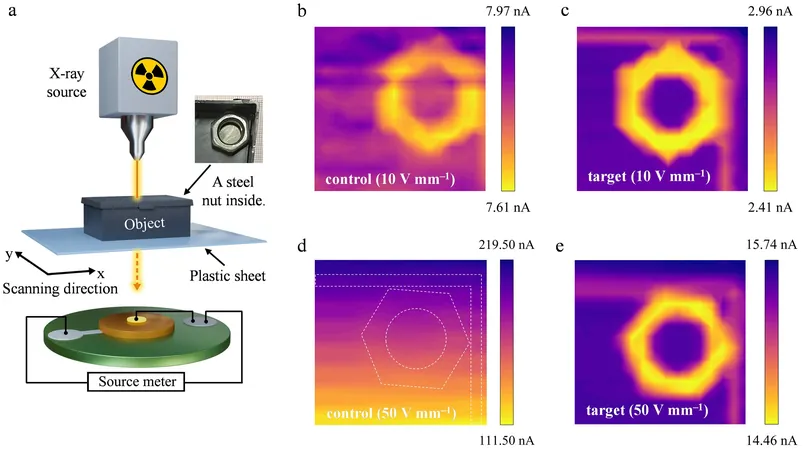
But the innovation doesn’t stop there! The researchers, in collaboration with Prof. Fang Xiaosheng from Fudan University, tackled the persistent issue of ion migration in polycrystalline CsPbBr₃ wafers, which are crucial for large-scale applications. Through a novel grain boundary passivation technique, they significantly elevated the ion migration activation energy to 0.56 eV. This breakthrough greatly reduced dark current drift under high electric fields, enabling their polycrystalline detector to achieve a detection limit of 9.41 nGyair·s⁻¹ while delivering exceptional image clarity.
A Game Changer for Medical Imaging!
The implications of these advancements are profound. CsPbBr₃ detectors promise to dramatically lower the radiation doses required for X-ray imaging, which is particularly crucial for sensitive populations, including children and pregnant women. This technological leap not only signals a bright future for X-ray detectors but also spearheads a shift towards safer, more precise radiation imaging technology.
Moving Towards a Safer Future!
As the research propels the evolution of radiation detection forward, medical professionals and patients alike can look forward to a world where X-ray imaging is not only clearer but also far less risky. This breakthrough exemplifies how innovation in material science can transform critical healthcare technologies.

 Brasil (PT)
 Canada (EN)
 Chile (ES)
 Česko (CS)
 대한민국 (KO)
 España (ES)
 France (FR)
 Hong Kong (EN)
 Italia (IT)
 日本 (JA)
 Magyarország (HU)
 Norge (NO)
 Polska (PL)
 Schweiz (DE)
 Singapore (EN)
 Sverige (SV)
 Suomi (FI)
 Türkiye (TR)
 الإمارات العربية المتحدة (AR)