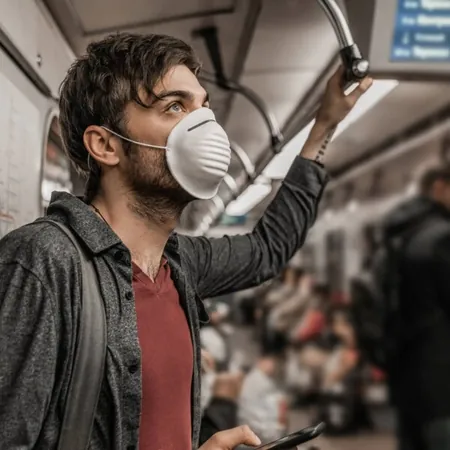
Breath of Fresh Air: Stricter Regulations Set to Transform Europe's Air Quality
2025-04-22
Author: Sarah
Air Pollution: The Silent Killer
Air pollution is an unseen assassin, claiming millions of lives prematurely each year across the globe.
WHO Takes a Stand: New Air Quality Guidelines
In response to alarming scientific findings connecting air pollution to grave health issues, the World Health Organization (WHO) overhauled its air quality guidelines in 2021, putting forth drastically stricter limits on harmful pollutants.
These ambitious changes have sparked a chain reaction in legislative measures throughout Europe, including a significant updates to the EU's Ambient Air Quality Directive.
Insights from Advocacy: A Discussion with Anna-Lena Franke
To delve deeper into the consequences of these new regulations, we chatted with Anna-Lena Franke, a prominent advocate from Deutsche Umwelthilfe (Environmental Action Germany).
Revolutionary Guidelines: What’s Changed?
The WHO's revised air quality guidelines represent a monumental shift, tightening limits on various pollutants based on comprehensive scientific reviews.
According to Anna-Lena, "Compared to the 2005 guidelines, the 2021 limits are far stricter across the board."
"For instance, the annual limit for particulate matter (PM2.5) has been slashed by 50%, down from 10 to just 5 micrograms per cubic metre. Even nitrogen dioxide (NO2) sees a staggering 75% cut, going from 40 to 10 micrograms per cubic metre."
EU Response: Tuning In to WHO Recommendations
Building on the WHO's recommendations, the EU has embarked on a revision of its Ambient Air Quality Directive to align legal limits with the heightened guidelines.
"The WHO's credibility in scientific research makes their recommendations influential in Europe," Anna-Lena notes, stressing new tangible outcomes in EU legislation.
Member states must adhere to these tightened pollutant limits by 2030, with those lagging behind by 2026 requiring to submit compliance roadmaps by 2028. Non-compliance could lead to infringement procedures and financial penalties.
Ripple Effects: Impact on Industries and Daily Life
The ramifications of stricter air quality regulations will be profound for industries contributing to air pollution, particularly in sectors like transportation, energy, and manufacturing.
"Industries reliant on fossil fuels will need to pivot towards cleaner energy sources and advanced filtration technologies to meet new standards," explains Anna-Lena.
On a broader scale, these regulations will catalyze behavioral shifts in everyday life, pushing for enhanced urban transportation systems favoring public transport, cycling, and walking over car dependency.
Monitoring the Unseen: New Pollutants Under the Microscope
While traditional pollutants remain a focus, the updated EU directive calls for new monitoring of previously neglected substances.
"Mandatory 'super sites' will track ultrafine particles, black carbon, and ammonia—pollutants that lacked standardized measurement before," Anna-Lena reveals, opening doors for better data and informed future regulation.
Overcoming Hurdles: Implementation Challenges
Implementing these ambitious reforms isn't without its challenges. One of the greatest obstacles is altering public behavior, as many resist changes that disrupt their daily lives. "People often resist change, especially in their commuting or home heating habits," Anna-Lena explains.
Addressing multiple pollution sources simultaneously also complicates matters. "There’s no one-size-fits-all solution. We must tackle pollution across sectors—transport, energy, industry, agriculture, and even residential heating."
Transportation: The Heart of Urban Pollution
Transportation stands as a key contributor to urban air pollution, largely due to nitrogen oxides and fine particulate matter emitted by vehicles.
"Cities struggle with transport pollution, so transitioning from fossil-fuel-powered vehicles to cleaner alternatives is vital," Anna-Lena emphasizes.
Electric Vehicles: Not the End of the Road
While electric vehicles (EVs) often receive praise, Anna-Lena cautions that they are not a panacea. "They still generate particulate matter through brake and tire wear and occupy the same urban space as traditional cars," she explains.
Future-Proofing Air Quality Regulations
The revised air quality guidelines are a powerful leap toward purer air, but their success hinges on effective enforcement.
"Without strong enforcement, even the best regulations are futile," warns Anna-Lena, urging governments to take genuine action over mere promises.
As research on air pollution progresses, Anna-Lena hopes the evolving understanding will drive adaptive regulatory updates.
A Crossroad for Public Health
Stricter air quality regulations signify a monumental stride toward enhancing public health and fostering environmental sustainability.
While challenges in implementation, particularly in balancing industry and public acceptance, loom on the horizon, the evidence remains clear: cleaner air translates to longer, healthier lives.
 Brasil (PT)
 Canada (EN)
 Chile (ES)
 Česko (CS)
 대한민국 (KO)
 España (ES)
 France (FR)
 Hong Kong (EN)
 Italia (IT)
 日本 (JA)
 Magyarország (HU)
 Norge (NO)
 Polska (PL)
 Schweiz (DE)
 Singapore (EN)
 Sverige (SV)
 Suomi (FI)
 Türkiye (TR)
 الإمارات العربية المتحدة (AR)