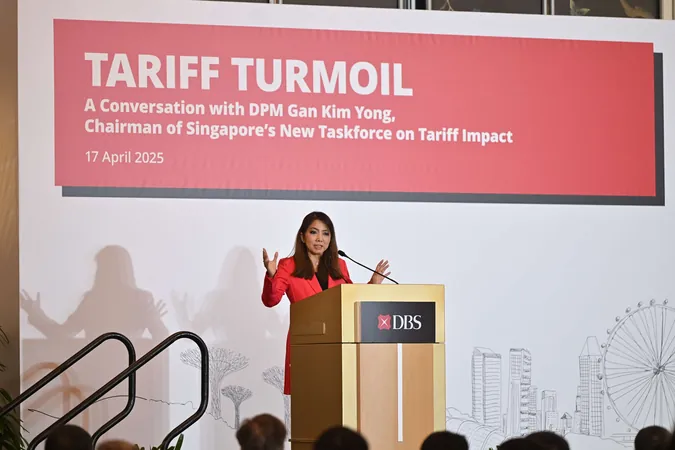
DBS CEO Tan Su Shan Unveils ‘Silver Linings’ for Asia Amid Trade Turmoil
2025-04-17
Author: Rajesh
In the shadow of escalating trade tensions and the potential decline of free trade, DBS CEO Tan Su Shan is championing a message of resilience and adaptability for Asia's business leaders. Speaking at a recent gathering in Singapore, she encouraged companies to leverage the shifting landscape for new opportunities.
A Call to Adapt
During the event, attended by notable figures including Deputy Prime Minister Gan Kim Yong, who leads Singapore's Economic Resilience Taskforce, Tan emphasized the importance of preparing for instability in the short term. "Expect volatility and uncertainty," she warned, urging businesses to remain agile.
Silver Linings in Tough Times
Yet, amidst the challenges, Tan urged leaders to maintain an optimistic perspective. "Are there any silver linings? We’re in Singapore!" she proclaimed, highlighting the region's robust economic potential.
Asia's Economic Powerhouse
Tan noted that Asia boasts 18 of the world's 20 fastest-growing trade corridors, and that a significant portion of trade—60%—now occurs within the region. Despite some slowdowns, Asia remains a hub, surrounded by economic giants like China, India, and Indonesia.
Navigating Complexity: Four Key Considerations
While maintaining a positive outlook, Tan outlined four critical points for business leaders to consider in navigating the evolving trade landscape: 1. **Supply Chain Resilience:** Companies should reassess their supply chains for sustainability, focusing on cost-effectiveness and market proximity, all while keeping pricing and planning adaptable. 2. **Logistics and Operational Adjustments:** She forecasted increased stockpiling of essential goods, urging firms to prepare for longer transportation routes and possible diversions.
3. **Innovative Financial Systems:** Tan highlighted the diminishing dominance of the US dollar in trade, emphasizing the need for alternative payment systems and digital innovations, such as blockchain and digital currencies.
4. **Tech Ecosystem Bifurcation:** As Eastern and Western tech systems develop divergently, companies must invest strategically to avoid incompatibility and high costs.
The Future of Trade: Potential Scenarios
DBS chief economist Taimur Baig supported Tan’s perspective by presenting four potential scenarios stemming from the US trade war. The most probable, with a 45% likelihood, sees a dual-track global trade model where companies adapt their strategies for both US and international markets.
Other scenarios include further escalation of tariff measures (30% probability), a symbolic trade deal between the US and China (20% chance), and the most dire outcome—a shift towards conflict (5% likelihood). Baig reassured attendees that despite current challenges, the global trade landscape remains vast and dynamic.
Looking Ahead
As traditional trade dynamics fluctuate, Baig reminded everyone that changes in US policy are cyclical, urging business leaders to stay poised for opportunities that lie ahead. "The current environment is not permanent," he noted, with hope for a return to more favorable trade conditions in the coming years.

 Brasil (PT)
 Canada (EN)
 Chile (ES)
 Česko (CS)
 대한민국 (KO)
 España (ES)
 France (FR)
 Hong Kong (EN)
 Italia (IT)
 日本 (JA)
 Magyarország (HU)
 Norge (NO)
 Polska (PL)
 Schweiz (DE)
 Singapore (EN)
 Sverige (SV)
 Suomi (FI)
 Türkiye (TR)
 الإمارات العربية المتحدة (AR)