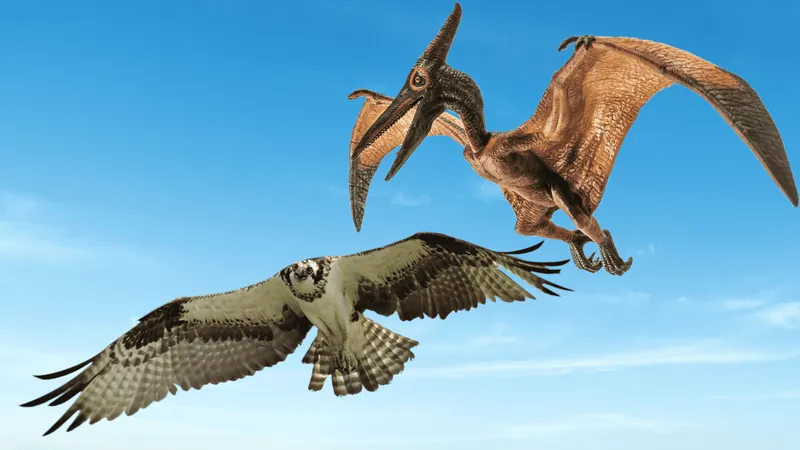
Dinosaur Catastrophe: How a 66 Million-Year-Old Event Lives On in Bird DNA
2025-04-21
Author: Ming
The cataclysm that brought the dinosaurs to their knees 66 million years ago didn't just mark the end of an era; it left a genetic signature on modern birds, the distant descendants of these ancient giants. Recent scientific discoveries delve into how this mass extinction continues to shape avian evolution today.
A Cataclysmic End to the Dinosaurs
The infamous Cretaceous-Paleogene extinction event obliterated 76% of Earth's animal species through a devastating asteroid impact. This catastrophic loss, however, paved the way for a rapid diversification of the surviving species, with the ancestors of modern birds taking their first steps into a new ecological landscape.
Emerging Avian Ancestry
In the wake of the extinction, the primitive ancestors of today’s birds emerged and began to evolve dramatically. These adaptive changes, encoded in their very DNA, chronicle a remarkable transition from dinosaurs to the birds we know today.
Unlocking the DNA Time Capsule
DNA, composed of the nucleotides A, C, G, and T, is far more than a biological blueprint; it's a historical artifact. Recent research reveals that shifts in these nucleotides correlate directly with the aftermath of the asteroid strike, creating a fascinating link between past cataclysms and contemporary avian evolution.
Revolutionary Analysis Tools
Earlier theories on bird evolution relied on static DNA models, but cutting-edge software has uncovered dynamic shifts in nucleotide ratios. This breakthrough has allowed scientists to pinpoint specific genetic alterations that arose during the pivotal period post-extinction, crucial for understanding modern bird evolution.
A Flourishing Evolutionary Window
Focusing on the 5 million years that followed the asteroid impact, researchers unearthed significant genetic shifts, vital for the emergence of defining avian traits like metabolism, size, and parental behaviors.
Size Matters: The Shift to Smaller Bodies
A key finding was the notable reduction in adult bird sizes following the extinction event. This downsizing may have been a vital adaptation, enabling survival and thriving in a radically altered environment.
Transforming Hatchling Dynamics
Another profound change was observed in bird hatchling development. Modern birds are often born naked and utterly dependent on parental care—a process starkly different from some ancient avian relatives, whose offspring were more autonomous at birth.
A Spectrum of Nestling Behavior
While most birds today exhibit these altricial traits, exceptions exist, such as ducklings and chicks, which are more self-sufficient. This implies that even these diverse traits have roots in the behaviors of ancestral avian dinosaurs, influenced by the extinction event.
DNA Changes Behind Bird Biology
This groundbreaking study highlights how genetic transformations relate to vital biological attributes in birds, confirming that the aftermath of the mass extinction is intricately woven into the fabric of bird biology.
Unearthing New Evolutionary Insights
The revelations from this research indicate that the repercussions of mass extinctions extend far deeper than previously understood. Such events not only disrupt ecosystems but also initiate significant shifts in the genetic architecture of surviving species, leading to fundamental changes in their biology.
A Legacy Engraved in Genes
The asteroid that closed the chapter of the dinosaurs has left an enduring legacy imprinted not just in fossils but within the very DNA of modern birds. As scientists navigate these genetic trails, they continue to unveil the profound and long-lasting effects of historical cataclysms on evolution, shedding light on one of Earth’s most resilient groups of animals.

 Brasil (PT)
 Canada (EN)
 Chile (ES)
 Česko (CS)
 대한민국 (KO)
 España (ES)
 France (FR)
 Hong Kong (EN)
 Italia (IT)
 日本 (JA)
 Magyarország (HU)
 Norge (NO)
 Polska (PL)
 Schweiz (DE)
 Singapore (EN)
 Sverige (SV)
 Suomi (FI)
 Türkiye (TR)
 الإمارات العربية المتحدة (AR)