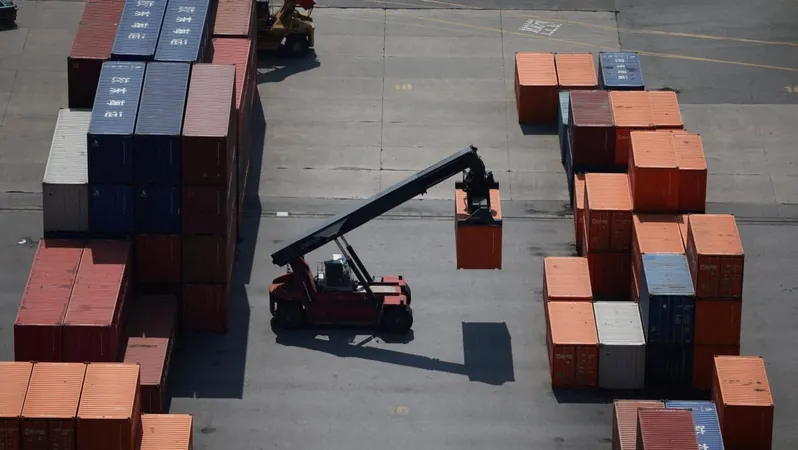
Economic Shock: South Korea Faces Unexpected Contraction Amid Trade Turmoil
2025-04-24
Author: Rajesh
In a staggering turn of events, South Korea's economy has shrunk by 0.1% in the first quarter of the year, according to the Bank of Korea. This unexpected contraction comes as the nation grapples with prolonged political instability and escalating trade tensions with the United States.
The situation has been exacerbated by US President Donald Trump’s alarming threat of imposing a 25% "reciprocal" tariff on South Korean exports, sending stocks plummeting and causing the won to hit its lowest value since 2009. Such unsettling dynamics have rattled one of Asia's largest economies.
The fallout from former President Yoon Suk Yeol's controversial attempt to suspend civilian rule has added fuel to the fire. This political crisis culminated in his impeachment just this month, further undermining confidence within the country.
"Real GDP has decreased by 0.1% compared to last year, and by 0.2% from the previous quarter," the central bank reported, shedding light on the worsening economic outlook.
"Two major factors are affecting confidence and the economy—Yoon Suk Yeol's failed martial law attempt and concerns surrounding US trade policy shifts," noted Hyosung Kwon, an economist at Bloomberg Economics. Nevertheless, Kwon remains cautiously optimistic, foreseeing a potential rebound in the second quarter as local political uncertainties start to wane.
Dramatic Decline in Exports
The economic landscape is particularly grim when it comes to exports, which have plummeted by over 5% compared to last year, with significant declines across nine of the ten major categories, excluding semiconductors. The ascent of tariffs has particularly hit exports to the United States, plummeting by more than 14%.
The International Monetary Fund has slashed its growth forecast for South Korea, cutting it from 2% to a mere 1% for this year, signaling a deeper economic malaise.
According to Kim Dae-jong, a professor at Sejong University, the South Korean economy is burdened with structural issues like high inflation and a weak won-dollar exchange rate, leading to an increasingly apparent slowdown in growth.
Bank of Korea Governor Rhee Chang-yong commented last week that the annual growth rate is now anticipated to fall short of the previously projected 1.5%. He warned that ongoing trade tensions and tariffs will likely further stunt growth prospects.
Adding to this dire situation are subdued domestic demands and natural disasters, such as large-scale wildfires that swept through the southeast in late March, all of which have contributed to the ongoing economic downturn.
 Brasil (PT)
 Canada (EN)
 Chile (ES)
 Česko (CS)
 대한민국 (KO)
 España (ES)
 France (FR)
 Hong Kong (EN)
 Italia (IT)
 日本 (JA)
 Magyarország (HU)
 Norge (NO)
 Polska (PL)
 Schweiz (DE)
 Singapore (EN)
 Sverige (SV)
 Suomi (FI)
 Türkiye (TR)
 الإمارات العربية المتحدة (AR)