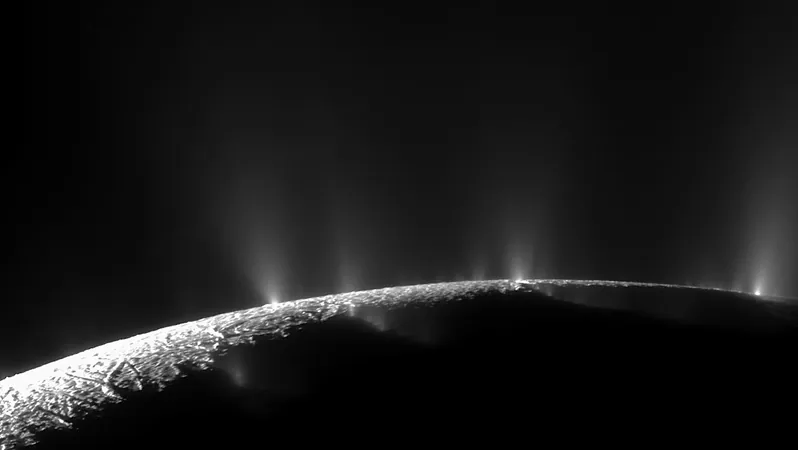
Enceladus: Are Its Icy Grains Hiding Life?
2025-04-21
Author: Ming
Revealing the Secrets of Enceladus's Ocean
In an exciting revelation from the depths of our solar system, researchers have been analyzing tiny ice grains shot into space by Saturn's enigmatic moon, Enceladus. Their findings suggest that beneath its icy crust, Enceladus's subsurface ocean might just be a haven for life!
Unraveling the Mystery of Ice Grain Formation
Yet, a big question remains: how are these ice grains formed? Recent experiments have delved into the process of supercooling as these ocean droplets freeze. Scientists have conducted high-speed cooling tests on mixtures simulating the moon’s salty water, discovering that these ice grains can transition into either a crystalline or glassy state depending on conditions.
How Fast Cooling Influences Ice Composition
The team's research unveiled that when cooling occurs rapidly—up to an astounding 1227 K per minute—ice grains emerge as predominantly crystalline with about 5% potentially forming glass. This rapid cooling, coupled with high salt content, could actually preserve organic materials and possibly even microscopic life forms!
A Peek into Enceladus's Mineral Makeup
Interestingly, the crystallization process of salts within these grains follows a specific order: phosphates crystallize first, followed by carbonates, and lastly chlorides. One of the recently identified phosphates is likely to be Na2HPO4:12H2O, offering a tantalizing glimpse into the moon's chemical landscape.
Insights for Other Icy Worlds
These promising insights into Enceladus's ice could also apply to other celestial bodies with similar subsurface oceanic conditions, like Jupiter's moon Europa and even the dwarf planet Ceres. The implications are staggering: could there be hidden life out there, waiting to be discovered?
Enceladus's Potential for Life
As scientists continue to unlock these mysteries, the potential for life beyond Earth becomes ever more tantalizing. The icy grains of Enceladus may not just be remnants of its ocean but key indicators of what lies beneath—a possible ecosystem just waiting to be explored.


 Brasil (PT)
 Canada (EN)
 Chile (ES)
 Česko (CS)
 대한민국 (KO)
 España (ES)
 France (FR)
 Hong Kong (EN)
 Italia (IT)
 日本 (JA)
 Magyarország (HU)
 Norge (NO)
 Polska (PL)
 Schweiz (DE)
 Singapore (EN)
 Sverige (SV)
 Suomi (FI)
 Türkiye (TR)
 الإمارات العربية المتحدة (AR)