Get Ready for a Celestial Spectacle: Partial Solar Eclipse on March 29, 2025!
2025-03-27
Author: Li
Mark your calendars, stargazers!
A stunning partial solar eclipse is set to grace the skies on March 29, 2025. This exciting astronomical event will be visible at sunrise across the northeastern United States and parts of Canada. Major cities like New York, Boston, and Portland are key viewing locations where you can witness this breathtaking phenomenon.
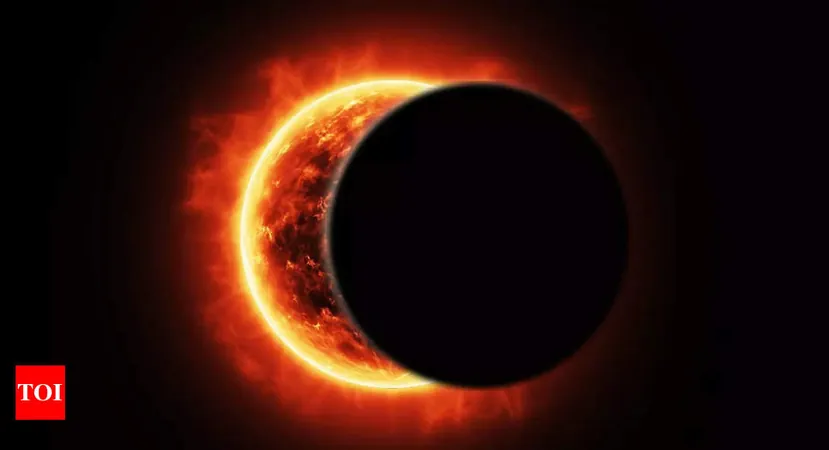
While a total solar eclipse completely hides the sun, a partial solar eclipse offers a unique visual treat where only a portion of the sun is obscured, creating a captivating crescent shape. This eclipse is expected to be one of the most-watched astronomical events of 2025, with an estimated 800 million spectators around the globe!
Timing and Viewing Locations in the U.S.
Get ready for the magic between 4:50 a.m. and 8:43 a.m. Eastern Time (ET). For the best viewing experience, head to these states at sunrise:
- **New York:** 6:35 a.m. to 7:12 a.m. - **Massachusetts:** 6:27 a.m. to 7:08 a.m. - **Maine:** 6:13 a.m. to 7:17 a.m. - **Pennsylvania:** 6:46 a.m. to 7:08 a.m. - **New Jersey:** 6:43 a.m. to 7:06 a.m. - **Virginia:** 6:50 a.m. to 7:03 a.m.
You'll also want to keep an eye on the skies in Connecticut, Delaware, Maryland, Rhode Island, New Hampshire, Vermont, West Virginia, and Washington, D.C. However, the ability to see the eclipse in all its glory will depend on local weather conditions, so fingers crossed for clear skies!
What to Expect from the Partial Solar Eclipse
The March 2025 eclipse is special because it will follow a lunar eclipse that occurs just weeks beforehand. As the moon passes between the Earth and the sun, it will create a dramatic "bite" effect on the sun, offering a rare opportunity for enthusiasts to marvel at the celestial mechanics at play. Partial eclipses, while less intense than total eclipses, still have their charm! You may notice intriguing environmental changes, like sharper shadows and changes in animal behavior, as the sunlight dims.
Safety First: Viewing the Eclipse Safely
Unlike lunar eclipses, partial solar eclipses require protective measures to safeguard your eyes. Looking directly at the sun during the event can lead to permanent retinal damage, so be sure to prepare! Use approved eclipse glasses that comply with ISO 12312-2 safety standards or solar viewing filters for safe viewing. Pinhole projectors and telescopes equipped with solar filters are excellent indirect viewing methods. Remember, regular sunglasses do not offer adequate protection!
Frequently Asked Questions About the 2025 Eclipse
**1. When is this partial solar eclipse happening?** The partial solar eclipse will occur on March 29, 2025, between 4:50 a.m. and 8:43 a.m. ET, peaking at sunrise. **2. What distinguishes a partial solar eclipse from a total solar eclipse?** A partial solar eclipse allows part of the sun to remain visible, resulting in a crescent shape, while a total solar eclipse completely covers the sun. **3. How can I safely observe this solar eclipse?** Use certified eclipse glasses, solar filters, or indirect viewing methods to protect your eyes from harmful rays during the event. **4. Why don’t solar eclipses occur every month?** The moon's tilted orbit does not perfectly align with Earth's orbit around the sun, making solar eclipses rare occurrences. **5. What environmental changes can I expect during the eclipse?** You may notice a slight cooling in temperature, deeper shadows, and shifts in animal activity as the sky darkens.
Prepare to be mesmerized by the wonders of our universe on March 29, 2025! Don't miss this chance to witness the beauty of the cosmos – it’s an experience you won’t want to ignore!

 Brasil (PT)
 Canada (EN)
 Chile (ES)
 Česko (CS)
 대한민국 (KO)
 España (ES)
 France (FR)
 Hong Kong (EN)
 Italia (IT)
 日本 (JA)
 Magyarország (HU)
 Norge (NO)
 Polska (PL)
 Schweiz (DE)
 Singapore (EN)
 Sverige (SV)
 Suomi (FI)
 Türkiye (TR)
 الإمارات العربية المتحدة (AR)