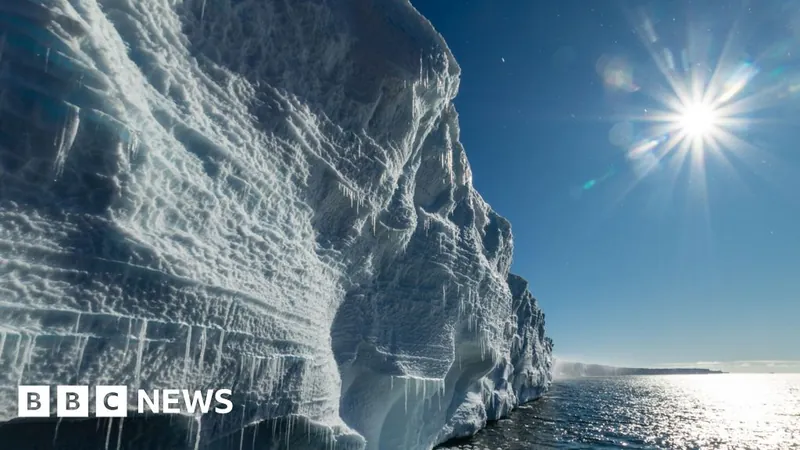
Giant Icebergs Revealed Off UK Coast: A Window Into Antarctica's Past
2025-04-24
Author: Arjun
City-Sized Icebergs Discovered Off UK Shore
Scientists have made a thrilling discovery off the coast of the UK: vast, city-sized icebergs, sometimes tens of kilometers wide, once drifted through these waters, leaving behind distinctive scratch marks on the sea floor. This revelation, dating back over 18,000 years, offers the first concrete evidence that the ancient ice sheet covering Britain and Ireland produced such colossal ice formations.
The findings not only shed light on the history of the British-Isles ice sheet but could also provide vital insights into how climate change impacts Antarctica today.
Unearthing the Past with High-Tech Seismic Data
Using advanced 3D seismic data—originally collected for oil, gas, and wind turbine projects—researchers conducted an in-depth analysis akin to an MRI of the sediment layers beneath today's seafloor, probing millions of years into the past.
The discovery of deep, comb-like grooves in the seafloor suggests that these icebergs, likely measuring between five to tens of kilometers wide and 50-180 meters thick, were produced by the massive British-Irish ice sheet. In fact, some of these geological markings lie just 90 miles off Scotland's eastern coast.
A Pioneering Study Unveils Gigantic Icebergs
James Kirkham, a marine geophysicist at the British Antarctic Survey and lead author of this groundbreaking study published in 'Nature Communications', states, "We found evidence of gigantic tabular icebergs, which indicates that the UK once had ice shelves, the only way to produce these immense structures."
Links to Modern-Day Climate Concerns
This discovery is particularly significant in today's context: Antarctica's ice shelves play a crucial role in holding back glaciers. If these ice shelves collapse, the glaciers can accelerate, contributing to rising sea levels worldwide. However, the exact implications of this process remain one of the greatest uncertainties in climate models.
By examining ancient icebergs, researchers can glean insights about potential scenarios for Antarctica as climate change progresses. A remarkable shift in Britain's icebergs occurred approximately 18,000 years ago, coinciding with a warming planet: large icebergs were replaced with smaller ones, hinting at the disintegration of ice shelves.
The Dilemma of Ice Shelf Disintegration
A crucial question remains: did the collapse of these ice shelves merely reflect a melting ice sheet, or did their fall directly trigger the rapid retreat of ice? Resolving this dilemma could illuminate the future impacts of losing current Antarctic ice shelves.
Eric Rignot, a glaciologist at the University of California, Irvine, notes that understanding these records could help clarify the essential role ice shelves play in regulating the flow of continental ice to the ocean.
This remarkable study not only reshapes our understanding of the past but also armors scientists with data essential for predicting the future of our planet in a warming world.
 Brasil (PT)
 Canada (EN)
 Chile (ES)
 Česko (CS)
 대한민국 (KO)
 España (ES)
 France (FR)
 Hong Kong (EN)
 Italia (IT)
 日本 (JA)
 Magyarország (HU)
 Norge (NO)
 Polska (PL)
 Schweiz (DE)
 Singapore (EN)
 Sverige (SV)
 Suomi (FI)
 Türkiye (TR)
 الإمارات العربية المتحدة (AR)