Hubble Space Telescope: Celebrating 35 Years of Cosmic Wonders
2025-04-23
Author: Wei
A Milestone Year for Hubble
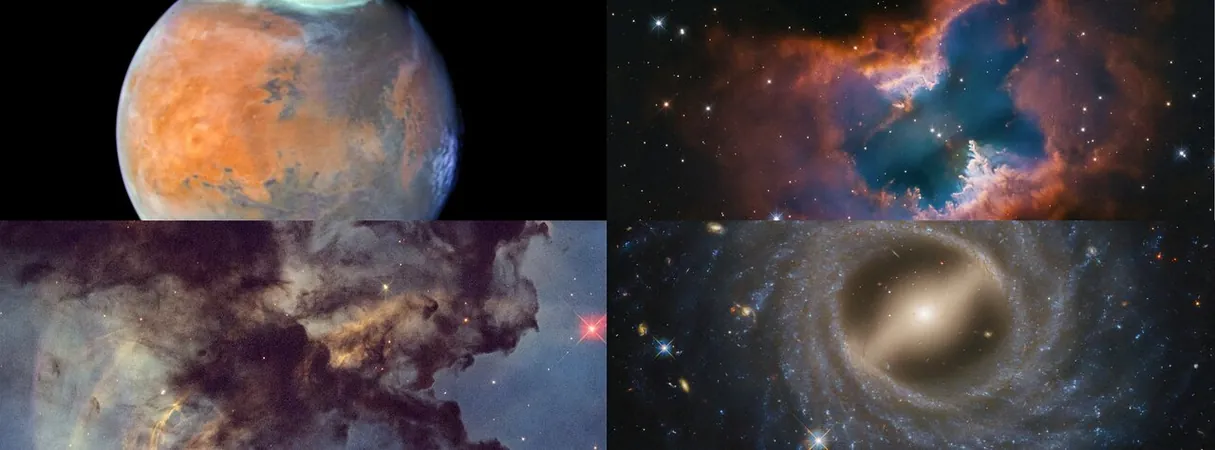
The Hubble Space Telescope, a cornerstone of astronomical discovery, is celebrating a remarkable 35 years in orbit around Earth. In honor of this momentous occasion, NASA and the European Space Agency (ESA) have unveiled a stunning collection of images captured by Hubble, showcasing everything from the Red Planet Mars to captivating stellar phenomena and neighboring galaxies.
A Leap Beyond Earth’s Horizon
Launched in 1990, Hubble transformed our understanding of the universe by providing crystal-clear images far superior to those possible from ground-based telescopes. This optical marvel operates above Earth's atmosphere, allowing astronomers to unveil celestial wonders with extraordinary clarity—ten times sharper than conventional telescopes of its time.
Breaking New Ground in Astronomy
Hubble’s contributions are monumental, marking a pivotal leap in both technology and human curiosity. The telescope's namesake, Edwin Hubble, laid the groundwork in the 1920s by discovering galaxies beyond our Milky Way, but Hubble took that vision further. With a staggering 1.7 million observations of approximately 55,000 targets, Hubble has propelled over 22,000 scientific papers and amassed over 1.3 million citations.
A Legacy of Discovery
Hubble's sustained operational life has allowed astronomers to witness monumental cosmic events over three decades. From black hole jets racing through space to spectacular supernova explosions, Hubble has chronicled the universe's evolving story.
Revolutionizing Our Cosmic Understanding
Before Hubble's launch, astronomical estimates about the universe were fraught with uncertainty. It played a crucial role in proving the existence of supermassive black holes, measuring the universe's expansion, and capturing spectacular images of distant galaxies.
Echoes of the Cosmos
Hubble has become synonymous with public engagement in science, often dubbed 'the people's telescope' due to its ability to make the cosmos accessible and fascinating for everyone. Its visually arresting snapshots convey not only the beauty and intricacy of the universe but also ignite curiosity about our place within it.
Stunning New Images Released
To commemorate its anniversary, Hubble has released breathtaking images of several astronomical targets:
- **Mars**: The images, captured between December 28th and 30th, 2024, showcase Mars adorned with thin water-ice clouds, signaling the onset of Martian spring.
- **Planetary Nebula NGC 2899**: This striking nebula features a unique cylindrical outflow sculpted by a luminous white dwarf, surrounded by a mesmerizing array of gaseous pillars.
- **Rosette Nebula**: Delving into a star-forming region over 5,200 light-years away, Hubble reveals stunning dark clouds of hydrogen, illuminated by the energetic activity of stars at its core.
- **Barred Spiral Galaxy NGC 5335**: This visual marvel showcases a galaxy with irregular star formations, illustrating the dynamic nature of galactic evolution.
Hubble's Impact Continues to Expand
Even at 35, Hubble shows no signs of slowing down. It remains a vital tool in exploring our universe, contributing to significant research on exoplanets, planetary atmospheres, and cosmic phenomena. Recent discoveries include the elusive Earendel, the most distant star ever observed.
A Beacon of Collaboration
The Hubble Space Telescope is a testament to international collaboration between NASA and ESA, with scientific operations managed by the Space Telescope Science Institute. Its legacy not only informs our understanding of the universe but also lays the groundwork for future explorations, such as the powerful James Webb Space Telescope.
In Conclusion: Hubble's Timeless Influence
Through its contributions and remarkable imagery, Hubble has redefined our cosmic narrative, forging a deeper connection between humanity and the universe. As we reflect on its 35 years of service, Hubble continues to inspire and illuminate our understanding of the cosmos.
 Brasil (PT)
 Canada (EN)
 Chile (ES)
 Česko (CS)
 대한민국 (KO)
 España (ES)
 France (FR)
 Hong Kong (EN)
 Italia (IT)
 日本 (JA)
 Magyarország (HU)
 Norge (NO)
 Polska (PL)
 Schweiz (DE)
 Singapore (EN)
 Sverige (SV)
 Suomi (FI)
 Türkiye (TR)
 الإمارات العربية المتحدة (AR)