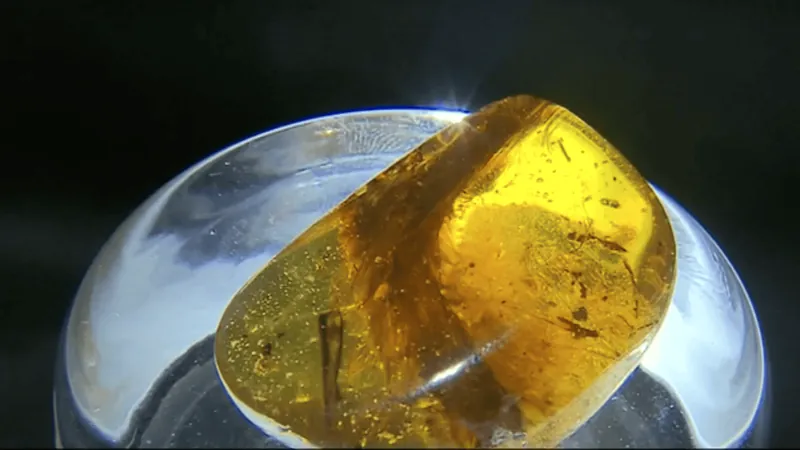
Incredible 99 Million-Year-Old Dinosaur Tail Found in Amber!
2025-04-23
Author: Li
A groundbreaking discovery has emerged from the world of amber, known for its remarkable ability to preserve ancient life. What appeared to be a lovely plant encased in this glorious substance has turned out to be something far more astonishing—a dinosaur tail! Let’s unravel this thrilling story!
What Is Amber?
Amber is fossilized tree resin that solidifies over millions of years. Its unique property of trapping ancient organisms provides exceptional insights into the past, making it a veritable golden portal to bygone eras.
The Preservation Marvel of Amber
Amber functions like a time capsule, capturing tiny creatures and plant materials in its protective embrace. As time passes, the resin transforms into amber, preserving specimens in remarkably pristine condition. This allows scientists to study these ancient forms of life as they once were, rather than merely through fossilized remains.
A Surprising Twist: Misidentification Galore!
Initially, the mysterious object trapped in amber seemed to be a fuzzy plant leaf, capturing the interest of scientists. However, a closer inspection revealed an unbelievable truth—it was actually a dinosaur's tail!
Unveiling the Specimen
Upon further examination, researchers discovered tiny feathers attached to the specimen. These feathers were unmistakably different from those of any plant and provided conclusive evidence that this was part of a small dinosaur! Talk about a plot twist!
Significance of This Discovery
This finding is revolutionary, as it serves as direct evidence that certain dinosaurs had feathers akin to today’s birds. It bridges gaps in our understanding of dinosaur evolution and alters our perspectives on these majestic ancient beings.
The Role of Feathers
Interestingly, the feathers on the tail were not designed for flight, hinting that they may have been utilized for display, insulation, or sensory functions. This revelation opens up avenues to understand how feathers influenced dinosaur behavior and lifestyles—imagine these majestic creatures sharing traits with modern chickens!
Clues About Dinosaur Behavior
The discovery of a feathered tail in amber offers vital clues about the dinosaur’s habitat and behaviors, suggesting that these creatures thrived in resin-producing tree environments, potentially adapting to lush forests.
Dinosaur Age and Habitat Revelation
The amber housing the dinosaur tail is an astounding 99 million years old, dating back to the mid-Cretaceous period when dinosaurs ruled the earth. This precious find provides a tantalizing glimpse into life during that extraordinary era.
Amber: A Paleontological Treasure
Amber has emerged as an indispensable resource for paleontologists, safeguarding specimens that could otherwise deteriorate. Past discoveries have included various plants, insects, and even larger organisms. This new find underscores amber's importance in unraveling the mysteries of ancient life—truly an extraordinary tool!
The Discovery Process
This remarkable amber piece was unearthed from a mine in Myanmar, a site renowned for significant amber discoveries. Researchers knew they had stumbled upon something unique, though the true significance of this find was beyond anyone's expectations.
Future Implications of the Discovery
This monumental discovery sparks new possibilities for understanding dinosaurs and their evolution, suggesting that more feathered relatives may yet await discovery. Future research will likely shed light on these creatures' lives, revolutionizing the artistic representation of dinosaurs.
The Ongoing Quest for More Discoveries
Scientists remain on the hunt for additional specimens encased in amber. Each new find expands our understanding of prehistoric life and allows us to gaze back into a time long before humanity roamed the earth. The hope is to uncover even more secrets about the ancient inhabitants that once walked our planet!
 Brasil (PT)
 Canada (EN)
 Chile (ES)
 Česko (CS)
 대한민국 (KO)
 España (ES)
 France (FR)
 Hong Kong (EN)
 Italia (IT)
 日本 (JA)
 Magyarország (HU)
 Norge (NO)
 Polska (PL)
 Schweiz (DE)
 Singapore (EN)
 Sverige (SV)
 Suomi (FI)
 Türkiye (TR)
 الإمارات العربية المتحدة (AR)