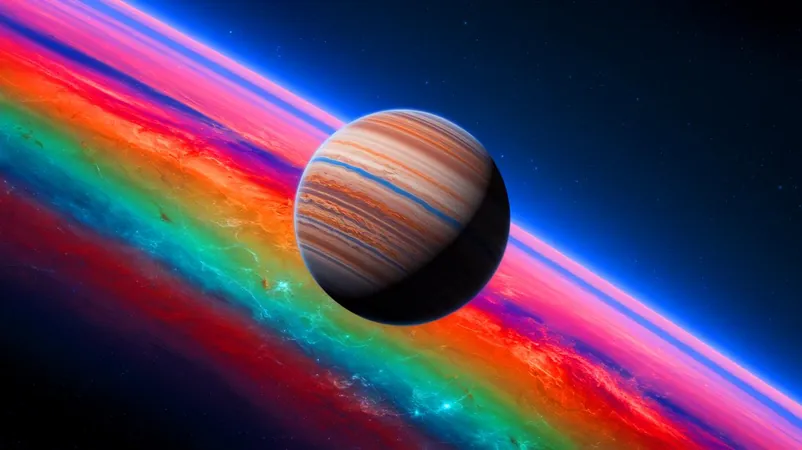
Is K2-18b Home to Alien Life? James Webb Telescope Reveals Shocking Discoveries!
2025-04-22
Author: Wei Ling
Astronomical Discovery Captivates the World
The universe is brimming with secrets, and a recent revelation from the James Webb Telescope regarding the exoplanet K2-18b has sent shockwaves through the scientific community! Situated a mind-boggling 124 light-years away in the Leo constellation, K2-18b is garnering immense interest from astronomers and space enthusiasts alike. The signals detected by Webb could herald groundbreaking insights into what might be a life-sustaining environment, igniting both excitement and curiosity.
K2-18b: A Planet Like No Other
Discovered a decade ago, K2-18b's massive size and peculiar features set it apart. Measuring 2.6 times Earth’s diameter and boasting a mass a staggering 8.6 times greater, it may harbor a mysterious ocean beneath its thick, hydrogen-rich atmosphere. The James Webb Telescope, outfitted with the MIRI instrument, is diligently peeling back the layers of this enigmatic world, promising unprecedented findings.
Chemical Clues Pointing to Life?
An international team of researchers has unearthed the presence of two intriguing molecules in K2-18b’s atmosphere: dimethyl sulfide (DMS) and dimethyl disulfide (DMDS). On Earth, such compounds are produced exclusively by marine life, hinting at possible biological activities. Moreover, the detection of methane and carbon dioxide adds complexity to the atmospheric puzzle.
Life on K2-18b: The Big Question
These exciting findings prompt a tantalizing question: is there a biosphere on K2-18b? Preliminary estimates suggest DMS levels are around 10 parts per million—far higher than what we’ve recorded on Earth! Although scientists caution that these compounds could stem from unknown geological processes, they recognize the significant implications for the search for life beyond our solar system.
Cautious Optimism Among Astronomers
At the University of Cambridge, the astrophysics team is buzzing with optimism tempered by caution. They understand that the identified molecules could arise from various processes specific to K2-18b, perhaps involving unknown chemical reactions or even a molten landscape hidden beneath its gas-rich cover. As researchers delve deeper, each new piece of data offers fresh insights into the life potential of this distant planet.
The Long Journey Ahead
While we remain grounded on Earth, pursuing K2-18b is currently out of reach—Voyager 1, for instance, would take over two million years to reach it, even at its impressive speed! Innovative projects like Breakthrough Starshot aim to fly at 20% the speed of light, challenging us to consider future exploration possibilities.
What Lies Ahead?
As we stand at the edge of what could be monumental discoveries, K2-18b pushes the boundaries of our cosmic understanding. The ongoing quest for extraterrestrial life remains one of humanity’s greatest pursuits. What astonishing revelations will the James Webb Telescope unveil next as it navigates the vast expanse of the cosmos?
 Brasil (PT)
 Canada (EN)
 Chile (ES)
 Česko (CS)
 대한민국 (KO)
 España (ES)
 France (FR)
 Hong Kong (EN)
 Italia (IT)
 日本 (JA)
 Magyarország (HU)
 Norge (NO)
 Polska (PL)
 Schweiz (DE)
 Singapore (EN)
 Sverige (SV)
 Suomi (FI)
 Türkiye (TR)
 الإمارات العربية المتحدة (AR)