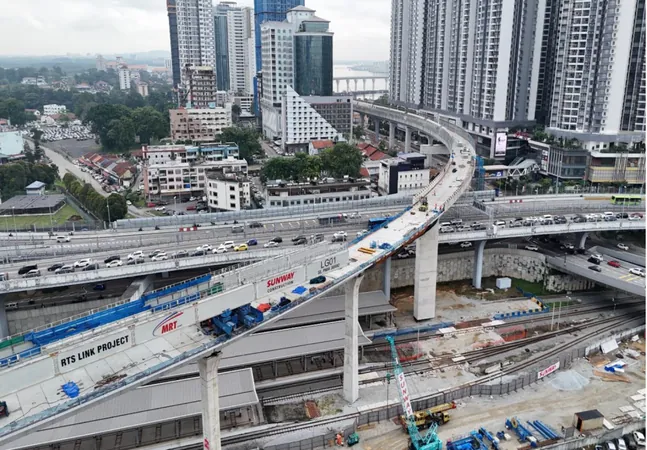
Is the Johor-Singapore RTS Project the Future of Connectivity for Malaysia?
2025-04-21
Author: Sarah
Revolutionizing Connectivity: The Johor-Singapore RTS
JOHOR BARU, April 22 — The upcoming Johor-Singapore Rapid Transit System (RTS), set to launch in 2027, is generating buzz as a potential "game changer." This ambitious project promises to transform travel between Johor and Singapore, creating smoother commutes and stronger economic ties.
A Welcome Solution to Congestion
Anticipated to relieve the staggering congestion of the Johor Causeway—one of the busiest land crossings globally—the RTS aims to streamline immigration processes and enhance talent mobility. This progress is aligned with the development goals of the Johor-Singapore Special Economic Zone (JS-SEZ), signaling a brighter economic future.
Investment and Talent: A Double-Edged Sword
Excited stakeholders herald the RTS as a beacon for new investments, tourism, and significant growth across various sectors. However, the enthusiasm is tempered by concerns over local industries' readiness to adapt to new labor dynamics and heightened competition for skilled workers.
Teh Kee Sin, adviser to the South Johor Small and Medium Enterprise Association, emphasizes the need for proactive strategies to combat existing manpower shortages, worsened by the COVID-19 pandemic. As businesses prepare for the influx of talents and tourists, the call for local employment solutions becomes increasingly urgent.
Capacity and Convenience: A Game Plan for Growth
Currently, the Johor Causeway sees a staggering 430,000 to 450,000 travelers daily. The RTS, equipped to handle 10,000 passengers per hour in each direction, is positioned to alleviate this burden, especially during peak times.
Real estate expert Samuel Tan points out that Johor's affordability and its proximity to Singapore make it an ongoing magnet for Malaysian workers. He urges businesses to enhance their value propositions to retain talent amid this competitive landscape.
Boosting Tourism: Optimism in Hospitality
Sectors like tourism and hospitality are particularly enthusiastic about the RTS. Ivan Teo, chairman of the Johor chapter of the Malaysian Association of Hotels (MAH), asserts that the RTS will likely enhance visitor inflow from Singapore, thus boosting hotel occupancy rates and improving wage offerings.
Teo believes the RTS can shift the reliance on weekend guests to more stable, year-round patronage, offering better wages for hotel staff, thereby increasing employee retention.
Empowering the Workforce: A Path to Resilience
While the RTS sets the stage for regional transformation, stakeholders agree that success will hinge on strategic planning. Tan advocates for investment in workforce upskilling and talent development, asserting that these efforts will help maintain a competitive labor market in Johor.
Yvonne Loh, secretary of Johor MAH, echoes this need, highlighting the importance of innovative employee development to discourage local talent from pursuing opportunities in Singapore.
A Future Full of Possibilities
Despite uncertainties, including ticket prices and evolving immigration policies, the RTS offers an unprecedented opportunity to reshape Johor’s economic landscape. As the region bolsters its industrial base and prepares a future-ready workforce, the RTS could redefine Johor as a bustling hub for commerce and tourism, enhancing the overall quality of life.
 Brasil (PT)
 Canada (EN)
 Chile (ES)
 Česko (CS)
 대한민국 (KO)
 España (ES)
 France (FR)
 Hong Kong (EN)
 Italia (IT)
 日本 (JA)
 Magyarország (HU)
 Norge (NO)
 Polska (PL)
 Schweiz (DE)
 Singapore (EN)
 Sverige (SV)
 Suomi (FI)
 Türkiye (TR)
 الإمارات العربية المتحدة (AR)