Is Your Rice Putting You at Risk? Alarming Arsenic Levels Could Spell Danger!
2025-04-20
Author: Yu
A Hidden Threat in Your Bowl of Rice
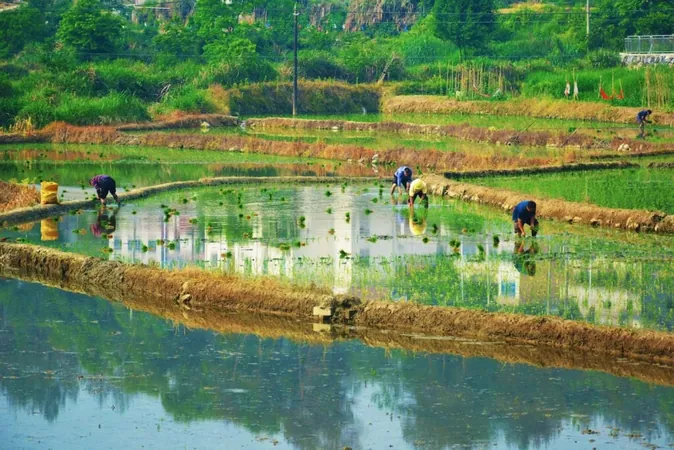
In the lush expanses of China’s Yangtze River Delta, a rice-growing paradise, farmers tirelessly cultivate green stalks, relying on centuries-old practices of flooding paddies. This method, essential for nurturing the globally beloved grain, is now showing dark signs as climate change intervenes.
Arsenic: A Deadly Contaminant in Our Food
New research published in *Lancet Planetary Health* brings to light a frightening revelation: after drinking water, rice is the world’s second-largest source of inorganic arsenic. This toxic element, known for its cancer-causing potential, poses heightened risks as global temperatures continue to rise.
A Decade of Research Unveils Disturbing Trends
Donming Wang, the lead researcher from the Institute of Soil Science, alongside his international team, invested nearly ten years examining how predicted temperature and CO2 levels in 2050 would exacerbate arsenic absorption in rice plants. The work focused on some of the most consumed rice varieties worldwide, primarily in nations like India, China, and Vietnam.
Climate Change: A Catalyst for Increased Arsenic Uptake
Remarkably, their findings revealed that as temperatures and CO2 levels rise, rice plants grow roots that absorb even more arsenic from saturated soils. The interaction creates a vicious cycle where warming conditions are not only beneficial for crop yields but also facilitate greater arsenic accumulation—a paradoxual twist!
The Health Risks: A Grim Prediction for the Future
According to Wang’s study, projections suggest that by 2050, under the direst climate scenarios, arsenic levels in rice may soar by an alarming 44%. This could lead to over 13 million cancer cases linked to rice consumption, particularly affecting vulnerable populations like infants and young children.
Global Response or Crisis?
Despite growing awareness, regulatory measures against arsenic in rice remain largely inconsistent. The European Union and China have set ambiguous guidelines, while the U.S. enforces minimal levels only for specific products like infant rice cereal. Wang urges for urgent policy changes to mitigate this looming public health crisis.
Strategies for Safer Rice Production
As consumers ponder their next meal, experts stress that stopping rice consumption is not the answer. Instead, adaptations such as earlier planting, better soil management, and new irrigation methods like alternate wetting and drying could greatly reduce arsenic risks.
The Call to Action: Addressing the Rice Crisis
The severity of this issue is not to be taken lightly. With rice being a staple food for billions, the cumulative health consequences of arsenic exposure could become catastrophic. As climate change continues to evolve, so must our responses to ensure that the world’s beloved grain does not come at such a dire cost.


 Brasil (PT)
 Canada (EN)
 Chile (ES)
 Česko (CS)
 대한민국 (KO)
 España (ES)
 France (FR)
 Hong Kong (EN)
 Italia (IT)
 日本 (JA)
 Magyarország (HU)
 Norge (NO)
 Polska (PL)
 Schweiz (DE)
 Singapore (EN)
 Sverige (SV)
 Suomi (FI)
 Türkiye (TR)
 الإمارات العربية المتحدة (AR)