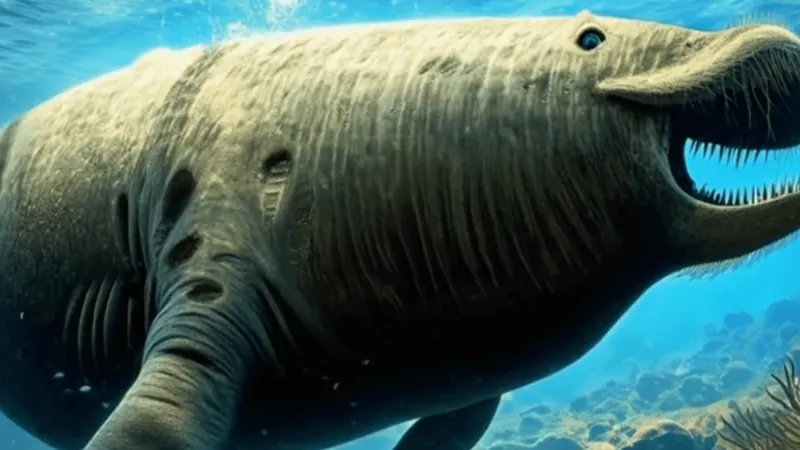
Jaw-Dropping Discovery: Ancient Sea Cow Fossil Reveals Shark and Crocodile Confrontation!
2025-04-19
Author: Nur
A Stunning Prehistoric Revelation
In a groundbreaking study, paleontologists have unearthed a fossil of a prehistoric sea cow that reveals the harrowing predation it faced from two fierce carnivores: a crocodile and a shark. This astonishing find not only illuminates ancient predation patterns but offers an intriguing look into the food chain during the Miocene epoch.
An Epic Showdown of Predators
Imagine a world 17 million years ago in present-day Venezuela, where a sea cow of the extinct genus Culebratherium faced a dire fate. The creature was first ambushed by a crocodile, only to become the target of a tiger shark soon after. Now, researchers are closely examining the sea cow’s skull to uncover the story behind its life and demise.
Unearthing the Past
Excavated from the rich deposits of northwestern Venezuela, these fossilized remains, including a partial skull and vertebrae, offer crucial insights into predator-prey dynamics that were previously unrecorded. This extraordinary discovery highlights interactions between species that have captivated scientists.
Evidence of Crocodile Assault
The skull showcases telltale tooth marks, suggesting that the crocodile’s attack was not just a mere chance encounter. Its sharp teeth targeted the snout of the helpless sea cow, likely aiming to subdue it using a technique known as the 'death roll,' reminiscent of today’s crocodilian tactics.
Sharks: The Ultimate Scavengers
Adding to the drama, marks and a particular tooth from a tiger shark indicate that this imposing predator cut in for a meal after the crocodile had its fill. This scavenging behavior is not just a relic of the past; it mirrors the feeding strategies of modern-day sharks!
Why This Discovery Matters
This fossil is a rare gem in paleontology, serving as one of the few examples that document multiple predators consuming the same prey. It provides a crucial window into the food chains of the Miocene era, offering an invaluable opportunity to understand the origins of today’s ecosystems.
Echoes from eons ago: Similarities with Today's Food Chains
This research reveals striking similarities between ancient and modern food chains. Not much has changed over millions of years, as crocodiles and sharks continue to target similar prey, showcasing the timelessness of nature’s instincts.
The Role of Sea Cows in Ancient Ecosystems
The study enhances our understanding of sea cows, highlighting their role as significant prey within ancient food webs, much like various large herbivores today. This fossil enriches previous studies on marine mammal predation.
A Jewel in the Fossil Record
Fossils exhibiting signs of multiple predators are an extraordinary rarity, making this discovery exceedingly valuable. It offers direct evidence of predator interactions within their environments, presenting a unique narrative of life thousands of years ago.
A Local Legacy
The fossil site, discovered in the Agua Clara Formation, has yielded remarkable paleontological finds over the years. Local farmers noted odd-shaped rocks, prompting further investigation that led to the exciting discovery of the sea cow remains.
Careful Excavation Reveals Wonders
Following meticulous excavation efforts that required multiple visits, paleontologists painstakingly extracted the fragile vertebrae and skull fragments. The excellent preservation of the sediments allowed for in-depth analysis of predation marks, revealing an ancient world preserved in time.
Final Thoughts: A Glimpse Through Time
This study not only provides a rare glimpse into the ancient ecosystems of the Miocene epoch but also unveils fresh insights into predator-prey interactions. Discovering how these ancient relationships influenced the evolution and structure of past ecosystems further enhances our understanding of the natural world today.
 Brasil (PT)
 Canada (EN)
 Chile (ES)
 Česko (CS)
 대한민국 (KO)
 España (ES)
 France (FR)
 Hong Kong (EN)
 Italia (IT)
 日本 (JA)
 Magyarország (HU)
 Norge (NO)
 Polska (PL)
 Schweiz (DE)
 Singapore (EN)
 Sverige (SV)
 Suomi (FI)
 Türkiye (TR)
 الإمارات العربية المتحدة (AR)