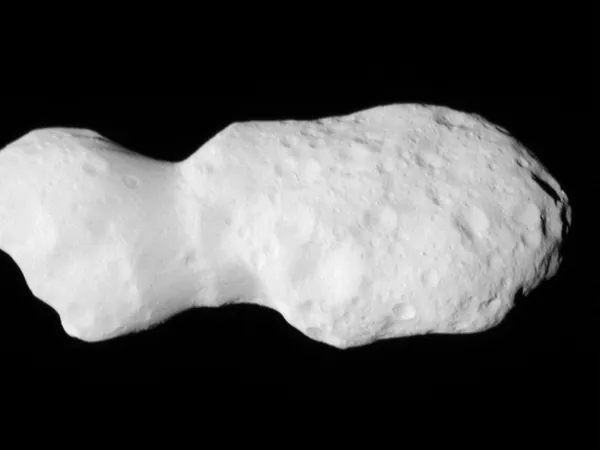
Lucy’s Astounding Encounter: A Peanut-Shaped Surprise From Space!
2025-04-23
Author: Nur
NASA's Lucy Spacecraft Dazzles with Astounding Asteroid Flyby!
On April 20, NASA’s Lucy spacecraft made an exhilarating close approach to the asteroid 52246 Donaldjohanson, zooming within just 600 miles (920 kilometers) of this fascinating celestial object nestled in the inner asteroid belt between Mars and Jupiter.
Named after the renowned paleontologist Donald Johanson, who co-discovered the iconic hominid fossil ‘Lucy’ in 1974, this mission aims to unearth secrets about our origins, mirroring the significance of its namesake.
A Visual Delight: Discovering Donaldjohanson’s Unique Shape!
The day following this thrilling encounter, NASA unveiled stunning images captured by Lucy’s Long Range Reconnaissance Imager (L'LORRII). To the surprise of scientists, Donaldjohanson measures 5 miles (8 kilometers) in length—larger than anticipated—and approximately 2 miles (3.5 kilometers) at its widest point.
What truly captivated astrophysicists, however, was the asteroid’s distinctive peanut shape, featuring two lobes linked by a narrow neck. This peculiar form resembles two nested ice cream cones and hints at its possible origins as an elongated contact binary, where two celestial bodies merge. Hal Levison, principal investigator for Lucy at Southwest Research Institute, commented on its strikingly complex geology, sparking excitement among the science community.
Unlocking Secrets: What’s Next for Lucy?
Over the upcoming weeks, data collected from Lucy’s additional onboard instruments will be processed to reveal colorful images and infrared spectra, offering vital insights into Donaldjohanson's surface composition, particle size, and radiation levels.
Lucy’s mission is far from over! For the next two years, the spacecraft will journey through the asteroid belt, with its next destination set for August 12, 2027. The target? The intriguing asteroid 3548 Eurybates and its satellite, Queta. These celestial bodies belong to a special group known as Trojan asteroids, linked gravitationally to Jupiter. As part of its ambitious course, Lucy will encounter a total of five Trojans and three satellite objects before concluding its mission with a flyby of the asteroid 617 Patroclus and its satellite Menoetius on March 3, 2033. Stay tuned for more stellar discoveries!
 Brasil (PT)
 Canada (EN)
 Chile (ES)
 Česko (CS)
 대한민국 (KO)
 España (ES)
 France (FR)
 Hong Kong (EN)
 Italia (IT)
 日本 (JA)
 Magyarország (HU)
 Norge (NO)
 Polska (PL)
 Schweiz (DE)
 Singapore (EN)
 Sverige (SV)
 Suomi (FI)
 Türkiye (TR)
 الإمارات العربية المتحدة (AR)