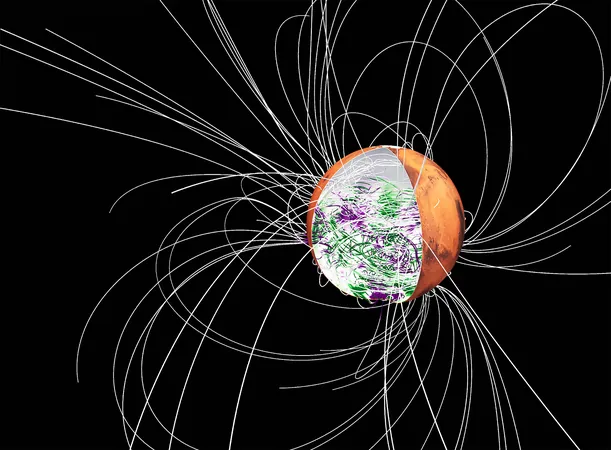
Mars: A Once Magnetic Marvel Now Only a Shadow of Its Former Self!
2025-04-18
Author: Ming
The Mystery of Mars' Magnetic Field Unveiled!
For years, scientists have been scratching their heads over why Mars, once draped in a global magnetic field akin to Earth's, now exhibits only fragmented traces—mostly in its southern hemisphere. A groundbreaking study from the University of Texas Institute for Geophysics (UTIG) shines new light on this cosmic enigma.
Could Mars Have Always Been One-Sided?
The UTIG researchers propose a tantalizing theory: what if Mars' ancient magnetic field was asymmetrically structured from its inception? Their model hints that a one-sided magnetic field might have evolved if Mars' core had been completely liquid during the period its magnetic force was active.
Buried Secrets in Martian Terrain!
Today, Mars lacks a global magnetic field. However, billions of years ago, it likely boasted one, generated by a planetary dynamo driven by molten metal movements within its core. Unlike Earth’s all-encompassing field, Mars left behind a lopsided magnetic imprint, predominantly recorded in its southern hemisphere.
This oddity has puzzled scientists for decades. Chi Yan, the study's lead author, believes that the secrets may lie deep within Mars' core, where a lack of a solid inner core could facilitate the production of hemispheric magnetic fields. He notes, "With no solid inner core, it’s much easier to create one-sided magnetic fields, which could impact our understanding of Mars’ ancient dynamo and the longevity of its atmosphere."
Why the Liquid Core Matters!
Historically, most models of Mars' ancient magnetic field were based on Earth's structure, featuring a solid inner core. However, NASA’s InSight mission has revealed surprising insights: Mars' core is likely richer in lighter elements like sulfur and oxygen than previously believed, suggesting it could be entirely molten.
"If Mars' core is molten today, it likely was 4 billion years ago when its magnetic field was still active,” adds Sabine Stanley, co-author of the study and a professor at Johns Hopkins University.
Heat Flow and Its Impact on Magnetism!
With the new proposal of a fully liquid core, the research team ran simulations contrasting a hot northern mantle with a cooler southern one. Their findings were astonishing. The simulation demonstrated that heat from the molten core escaped more readily through the southern hemisphere, generating a magnetic dynamo solely in that region.
This discovery aligns with the magnetic features observed in Martian rocks today, exciting the researchers who stated, "We can create a hemispheric magnetic field that reflects Mars' current interior structure as revealed by InSight."
 Brasil (PT)
 Canada (EN)
 Chile (ES)
 Česko (CS)
 대한민국 (KO)
 España (ES)
 France (FR)
 Hong Kong (EN)
 Italia (IT)
 日本 (JA)
 Magyarország (HU)
 Norge (NO)
 Polska (PL)
 Schweiz (DE)
 Singapore (EN)
 Sverige (SV)
 Suomi (FI)
 Türkiye (TR)
 الإمارات العربية المتحدة (AR)