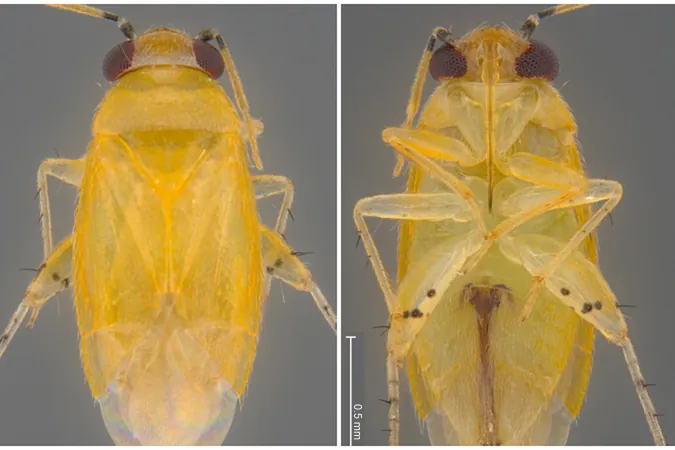
Meet Campylomma singapura: The New Bug That's Making Singapore Proud!
2025-04-18
Author: Jia
A New Bug for Singapore!
In a surprising twist for the biodiversity of the Lion City, researchers at the National University of Singapore (NUS) have unveiled a new species of plant bug—the Campylomma singapura. This tiny critter, discovered right at the heart of the NUS campus, is now officially a resident of Singapore!
The Discovery Journey
The groundbreaking revelation was shared in a paper published on March 24 in the journal Zootaxa, by experts from the Lee Kong Chian Natural History Museum. This insect was unearthed during an exciting survey of plants on campus, led by Dr. Hwang Wei Song, along with mirid specialist Dr. Tomohide Yasunaga and local naturalist Yap Ee Hean.
During their plant survey last August, Dr. Yasunaga stumbled upon a sea hibiscus tree on Kent Ridge Drive. Upon examination, they found several mirid bugs hidden under its flowers, leading to the collection of samples that were later identified as a brand new species.
What Makes Campylomma singapura Special?
Unlike typical mirids that generally feast on plants, Campylomma singapura showcases a fascinating diet that includes both plants and insects, specifically thrips—small pests often found in flowers. This adaptability not only makes them interesting but also positions them as potential biological control agents against agricultural pests.
Remarkable Resilience in Urban Singapore
Dr. Hwang expressed excitement over this discovery, stating that the extensive presence of their host plant throughout Singapore suggests a healthy population of these bugs. He praised the incredible adaptability of this newly identified species, which has thrived amidst urban development yet remained unnoticed until now.
A Tribute to Singapore's Biodiversity
Interestingly, Campylomma singapura is part of a growing list of species celebrating their connection to Singapore. As of 2015, at least 95 species, ranging from plants to mollusks, have been named in honor of the nation. Dr. Hwang regarded this finding as a fitting tribute as Singapore marks its 60th anniversary of independence.
He emphasized that even in a highly urbanized environment, rich biodiversity flourishes, showcasing the resilience of our local insect populations. This new species truly embodies what it means to be a 'Singapore Citizen'.
What’s Next for the Researchers?
Excitingly, the team has plans to delve deeper into the world of mirids, reinforcing the notion that despite being under-researched, this region is brimming with a vast array of insect life waiting to be explored.


 Brasil (PT)
 Canada (EN)
 Chile (ES)
 Česko (CS)
 대한민국 (KO)
 España (ES)
 France (FR)
 Hong Kong (EN)
 Italia (IT)
 日本 (JA)
 Magyarország (HU)
 Norge (NO)
 Polska (PL)
 Schweiz (DE)
 Singapore (EN)
 Sverige (SV)
 Suomi (FI)
 Türkiye (TR)
 الإمارات العربية المتحدة (AR)