Meet the ‘Curiously Isolated’ Butterfly Newly Discovered in Canada’s Rocky Mountains
2025-04-21
Author: Mei
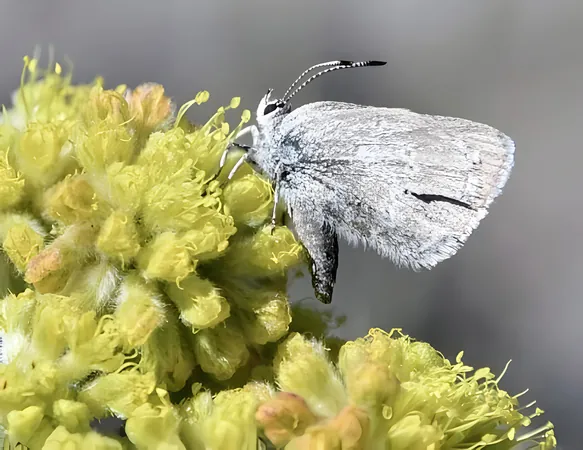
In the breathtaking wilderness of Canada’s Rocky Mountains, researchers have unveiled a hidden gem: a completely new species of butterfly! Long thought to be the Half-moon Hairstreak, these butterflies from the Blakiston Fan region have been newly named Satyrium curiosolus, or the Curiously Isolated Hairstreak.
This groundbreaking discovery shines a light on the butterfly's unique evolutionary journey. The research indicates that it has been genetically separated from its closest relatives for an astonishing 40,000 years, leading to the development of a distinct population both genetically and ecologically.
The Isolated Wonder of the Rockies
Zac MacDonald, a postdoctoral researcher at UCLA, who contributed to the study, shared fascinating insights: "Our whole-genome sequencing of S. curiosolus revealed lower genetic diversity and notable historical inbreeding when compared to populations of its nearest relative, S. semiluna, located over 400 kilometers away in British Columbia and Montana.”
Despite its petite size, this butterfly has remarkably thrived independently for millennia. Like the Channel Island Fox, S. curiosolus may have gradually discarded harmful recessive genetic traits over time, allowing it to maintain a small yet resilient and isolated population.
A Unique Habitat and Lifestyle
Unlike its relatives, this butterfly occupies a distinctive prairie-grassland habitat. It has adapted beautifully to its environment, relying solely on silvery lupine as its exclusive host plant—a stark contrast to the diet of S. semiluna which prefers sagebrush.
In an intriguing twist, researchers discovered a mutualistic relationship between S. curiosolus larvae and a particular ant species, Lasius ponderosae. The caterpillars produce honeydew, a sugary secretion that ants consume while offering protection against predators in return.
Challenges Ahead: Conservation and Research Needs
Awareness of S. curiosolus as a distinct species is vital for conservation efforts. Its long-standing isolation leads to low genetic variability, making the butterfly vulnerable to climate shifts and environmental changes. Introductions from related populations to enhance genetic diversity could backfire due to risks like outbreeding depression—making alternative strategies essential.
Co-first author, Julian Dupuis from the University of Kentucky, reflects on the discovery: "This highlights how genomics is transforming taxonomy and conservation, pointing towards a future where conservation strategies are informed by previously hidden diversity."
The Importance of Collaboration
The incredible findings were made possible through a partnership between academic institutions, national parks, and conservation organizations. Zac MacDonald emphasizes this collaboration, noting: "Our work on S. curiosolus illustrates the impact of teamwork between scientists, Parks Canada, and conservation managers. Together, we can reshape our understanding of biodiversity and devise protective measures for species like this one."
Looking Forward: The Future of the Curiously Isolated Hairstreak
Now that Satyrium curiosolus has been officially recognized, further studies are critical to understanding its evolutionary relationships, interactions with plants and ants, and its resilience to climate change. Monitoring efforts led by Parks Canada and Wilder Institute/Calgary Zoo will play a pivotal role in ensuring its ongoing survival.
As we uncover more about this ‘Curiously Isolated’ butterfly, it serves as a poignant reminder of how even the smallest creatures can significantly influence our understanding of biodiversity and conservation efforts for generations to come.

 Brasil (PT)
 Canada (EN)
 Chile (ES)
 Česko (CS)
 대한민국 (KO)
 España (ES)
 France (FR)
 Hong Kong (EN)
 Italia (IT)
 日本 (JA)
 Magyarország (HU)
 Norge (NO)
 Polska (PL)
 Schweiz (DE)
 Singapore (EN)
 Sverige (SV)
 Suomi (FI)
 Türkiye (TR)
 الإمارات العربية المتحدة (AR)