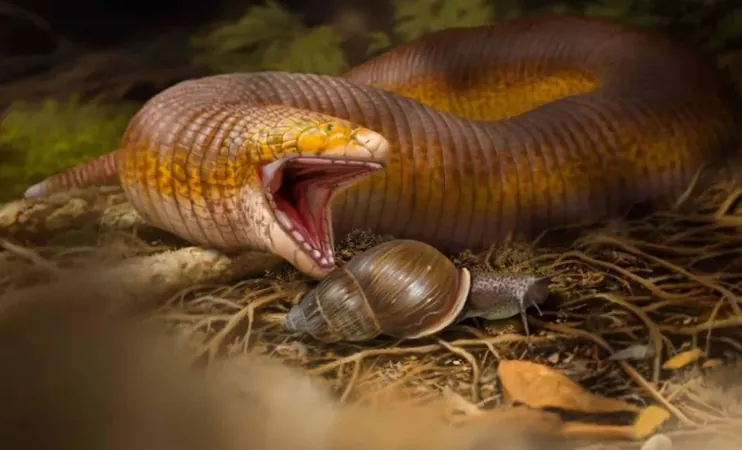
Meet the Mammoth-Worm: Prehistoric Giant Discovered from 50 Million Years Ago!
2025-04-20
Author: John Tan
A Stunning Discovery in Paleontology
Prepare to be amazed! Paleontologists have uncovered a jaw-dropping prehistoric species named **Terastiodontosaurus marcelosanchezi**, which has just clinched the title of the largest worm lizard known to science. This astonishing find, detailed in the *Zoological Journal*, measures over 3 feet long and shatters previous perceptions of these burrowing reptiles.
The Groundbreaking Ancient Reptile
Unearthed in Tunisia's **Djebel Chambi National Park**, these fossils date back around 50 million years, during the Eocene epoch. Unlike today's smaller worm lizards, which lack limbs and thrive underground, this colossal creature most likely roamed the Earth’s surface.
Lead researcher **Georgios Georgalis** points out, “This is large for amphisbaenian standards!” Their discovery flips traditional views on the biology and ecology of these squamate reptiles.
Giant Sandworm or Ancient Predator?
The formidable size and powerful jaw of T. marcelosanchezi have sparked comparisons with the legendary **sandworms** from the *Dune* franchise. Georgalis notes that the visual and functional similarities are uncanny, as this ancient predator would have used its crushing jaws to devour hard-shelled prey like snails.
“Based on the structure of its teeth and unusually thick enamel, we can infer that this creature possessed enormous jaw strength,” he explains.
A Record-Breaking Worm Lizard!
With a skull surpassing 2 inches in length, T. marcelosanchezi outshines all previously known worm lizards—both extinct and living. Scientists believe it belongs to the **Trogonophid family**, a unique North African lineage of worm lizards distinguished by their unique skull, tooth structure, and behaviors.
The fossil evidence—primarily jaws and vertebrae—indicates multiple individuals existed, providing a deeper insight into this remarkable creature.
Climatic Clues About Size Boosts
The research suggests that the size of this ancient beast is linked to the warmer global climate of the Eocene epoch. Co-author **Krister Smith** from the Senckenberg Research Institute posits, “Our findings indicate that the oddly large body size may relate to the higher temperatures of that era.” This observation resonates with other findings indicating that elevated temperatures favor larger body sizes in ancient reptiles.
An Evolutionary Marvel with a Powerful Bite
While modern trogonophids are rarely larger than a few inches, T. marcelosanchezi was an evolutionary outlier. Researchers identified unique and extreme dental features that likely equipped this giant with a fearsome bite, making it an apex predator in its ecosystem.
The combination of its massive size and surface-dwelling lifestyle marks a significant evolutionary step away from the buried existence of its modern relatives. This discovery challenges what we thought we knew about prehistorical life and highlights the fascinating adaptability of nature!
 Brasil (PT)
 Canada (EN)
 Chile (ES)
 Česko (CS)
 대한민국 (KO)
 España (ES)
 France (FR)
 Hong Kong (EN)
 Italia (IT)
 日本 (JA)
 Magyarország (HU)
 Norge (NO)
 Polska (PL)
 Schweiz (DE)
 Singapore (EN)
 Sverige (SV)
 Suomi (FI)
 Türkiye (TR)
 الإمارات العربية المتحدة (AR)