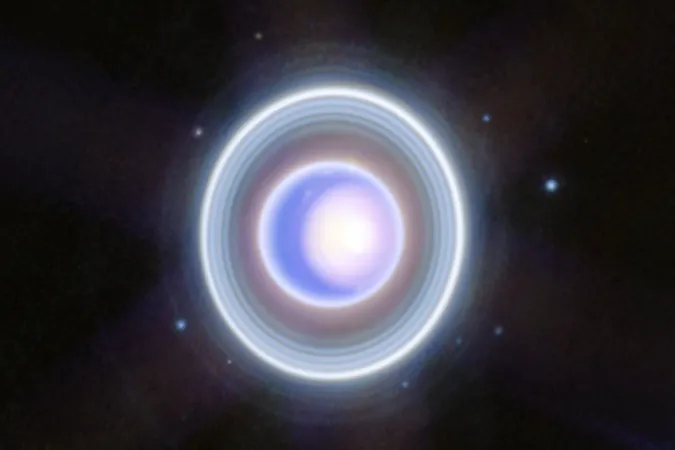
NASA Unlocks Secrets of Uranus During Rare Cosmic Alignment!
2025-04-23
Author: Wei
On April 7, a once-in-a-lifetime cosmic event unfolded as Uranus glided in front of a distant star 400 light-years away, offering NASA a unique chance to explore the enigmatic ice giant.
This celestial occurrence, known as a stellar occultation, allowed Uranus' atmosphere to refract the star's light, dimming it before blocking it entirely. Surprisingly, this dimming presented scientists with an opportunity to uncover hidden aspects of Uranus that are usually shrouded in mystery.
A collaborative effort of 30 astronomers across 18 observatories in North America captured this event. They meticulously analyzed the resulting light curve—a visual representation of how the star's brightness altered over time. From this curve, critical information emerged about Uranus’ stratosphere, including temperature, density, and pressure at various altitudes.
NASA planetary scientist William Saunders emphasized the significance of these observations, stating, “This data will help us understand how energy circulates in Uranus’ atmosphere and clarify why its upper layers are so inexplicably hot.” Beyond that, researchers will utilize this data to gain insights into Uranus’ rings, atmospheric turbulence, and its precise trajectory around the Sun.
Despite its staggering distance of nearly 2 billion miles from the Sun, Uranus bafflingly boasts an upper atmosphere that is hotter than expected, and the newly acquired light curve may hold the answers.
This unprecedented endeavor marks NASA’s first large-scale coordinated observation of a Uranus occultation. A test run in November 2024 helped refine the timing and pinpointed Uranus' position with remarkable accuracy, adjusting it by 125 miles—no small feat when aiming telescopes at a moving celestial object so far away.
In addition to its mysterious atmosphere, the event also provided crucial data on Uranus' complex ring system and its orbital position, which has remained unclear since Voyager 2’s flyby in 1986.
Uranus, with its 13 rings and 27 moons, represents a tantalizing puzzle for scientists. Made primarily of hydrogen, helium, and a cocktail of other elements, this ice giant is essentially a cold, gassy slushy with violent storms.
Looking forward, NASA is already gearing up for another exciting occultation of Uranus set for 2031, which will feature an even brighter background star. This may pave the way for airborne or space-based observations, further unraveling the secrets of this unique planet, with its tilted axis, mysterious rings, and Shakespearian moons.
 Brasil (PT)
 Canada (EN)
 Chile (ES)
 Česko (CS)
 대한민국 (KO)
 España (ES)
 France (FR)
 Hong Kong (EN)
 Italia (IT)
 日本 (JA)
 Magyarország (HU)
 Norge (NO)
 Polska (PL)
 Schweiz (DE)
 Singapore (EN)
 Sverige (SV)
 Suomi (FI)
 Türkiye (TR)
 الإمارات العربية المتحدة (AR)