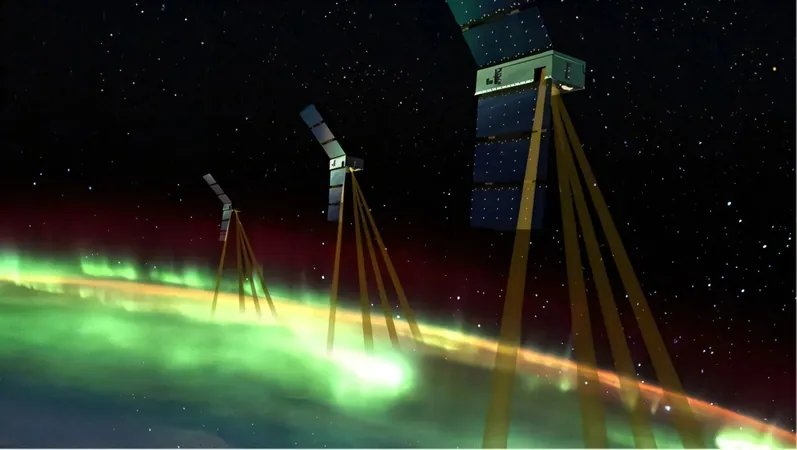
NASA's Groundbreaking EZIE Mission Captures Stunning 'First Light' Observations!
2025-04-24
Author: Arjun
In an exciting breakthrough for space exploration, NASA's EZIE (Electrojet Zeeman Imaging Explorer) mission has successfully captured its first measurements.
These eye-opening "first light" observations signal that EZIE is set to unveil critical insights into Earth’s auroral electrojets—powerful electric currents that dance through our upper atmosphere where mesmerizing auroras light up the night sky.
Launched in March with a fleet of three CubeSats, EZIE is on a mission to map these dynamic auroral electrojets from a close-up perspective like never before. These striking currents form in the polar regions of our atmosphere, approximately 65 miles (105 kilometers) above the Earth, fueled by vast amounts of energy transferred from the solar wind. This same phenomenon sparks the spectacular northern and southern lights that captivate stargazers.
The spacecraft are equipped to measure the strength and direction of these currents by examining the emissions from oxygen molecules located about 10 miles (16 kilometers) beneath the electrojets. These oxygen molecules emit microwaves at a striking frequency of 118 gigahertz.
However, when subjected to magnetic fields—like those generated by the electrojets—these emissions exhibit a fascinating phenomenon known as Zeeman splitting. The intensity of the magnetic field dictates the extent of this splitting; a stronger magnetic field corresponds to a wider separation of the 118 GHz line. By analyzing the polarizations of the oxygen emissions, scientists can decipher the direction of the magnetic field.
On March 19, the mission achieved a major milestone: one of the three EZIE satellites successfully detected Zeeman splitting of the 118 GHz oxygen emission line for the very first time using its Microwave Electrojet Magnetogram (MEM) instrument. This groundbreaking observation reveals not only the strength but also the direction of the magnetic field at play—specifically, Earth's magnetic field near the magnetic equator.
Sam Yee, the principal investigator from the Johns Hopkins Applied Physics Laboratory, expressed his enthusiasm, stating, "The EZIE team is very excited about these first-light results. The observations show that both the spacecraft and the MEM instrument onboard are functioning precisely as intended."
As the EZIE mission continues, formal scientific investigations are poised to commence in about a month, following a series of final checkouts and calibrations. Stay tuned for more thrilling discoveries from this pioneering mission!
 Brasil (PT)
 Canada (EN)
 Chile (ES)
 Česko (CS)
 대한민국 (KO)
 España (ES)
 France (FR)
 Hong Kong (EN)
 Italia (IT)
 日本 (JA)
 Magyarország (HU)
 Norge (NO)
 Polska (PL)
 Schweiz (DE)
 Singapore (EN)
 Sverige (SV)
 Suomi (FI)
 Türkiye (TR)
 الإمارات العربية المتحدة (AR)