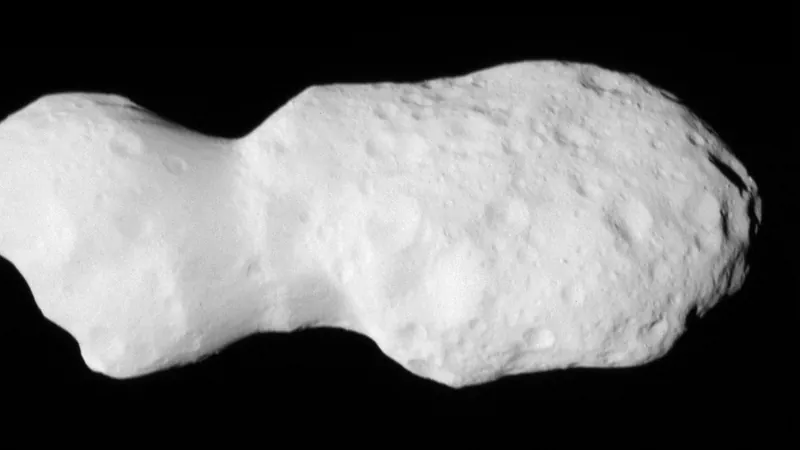
NASA's Lucy Spacecraft Reveals Stunning Peanut-Shaped Asteroid
2025-04-23
Author: Jia
Lucy’s Incredible Close Encounter with Asteroid Donaldjohanson
NASA's Lucy spacecraft achieved a groundbreaking moment by capturing its first high-resolution images of a uniquely shaped peanut-like asteroid named Donaldjohanson. This ancient rock, roughly 150 million years old, was formed from a collision between two smaller asteroids, resulting in its distinctive lobed appearance.
Astounding Close-Up from 600 Miles Away
On April 20, Lucy soared within 600 miles (960 kilometers)—about the span of Montana—of Donaldjohanson, allowing scientists to snap their first detailed glimpses of this fascinating celestial body. Researchers believe that studying this asteroid could unravel mysteries surrounding the formation of the Solar System's planets.
Unlocking Secrets of Planetary Origins
Hal Levison, the principal investigator for Lucy at the Southwest Research Institute in Colorado, expressed excitement about the asteroid’s complex geology: "Donaldjohanson has strikingly complicated geology. Each detail we uncover will contribute important insights into the collisional processes that shaped the planets in our Solar System."
A Mission with Grand Ambitions
Launched in 2021, the Lucy mission aims to explore ancient asteroids located around 445 million miles (715 million km) from Earth, particularly targeting the Trojan asteroids. These ancient space rocks, much older than Donaldjohanson, reside in two groups flanking Jupiter and could provide vital historical context on the primordial materials that formed giant planets like Jupiter, Neptune, and Saturn.
Meet Donaldjohanson: A Size Perspective
Donaldjohanson, measuring approximately 5 miles (8 km) long and 2 miles (3.5 km) wide, is significantly smaller than some of its Trojan counterparts. For comparison, Lucy’s first Trojan target, Eurybates, is a colossal 40 miles (64 km) across.
A Tribute to a Groundbreaking Discovery
Named after American paleoanthropologist Donald Johanson—famous for discovering the groundbreaking Australopithecus fossil "Lucy"—this mission draws a parallel. Just as the fossil provided insights into human evolution, researchers hope Lucy will illuminate the origins of planets.
Capturing the Images and Looking Ahead
Using the Lucy Long-Range Reconnaissance Imager, the spacecraft managed to capture images of the asteroid, although its full shape won't be fully visible due to the size limitations of the camera's field of view. As more data comes in, researchers eagerly await a clearer picture of Donaldjohanson.
A Successful Test Run Prepares for Major Exploration
Lucy’s previous flyby of asteroid Dinkinesh in 2023 was a crucial test of its systems, but the recent encounter with Donaldjohanson was deemed a "full dress rehearsal" for the upcoming visit to its first Trojan asteroid in 2027. This mission not only promises to deepen our understanding of the Solar System's history but also ignites a sense of wonder about our cosmic origins.
 Brasil (PT)
 Canada (EN)
 Chile (ES)
 Česko (CS)
 대한민국 (KO)
 España (ES)
 France (FR)
 Hong Kong (EN)
 Italia (IT)
 日本 (JA)
 Magyarország (HU)
 Norge (NO)
 Polska (PL)
 Schweiz (DE)
 Singapore (EN)
 Sverige (SV)
 Suomi (FI)
 Türkiye (TR)
 الإمارات العربية المتحدة (AR)