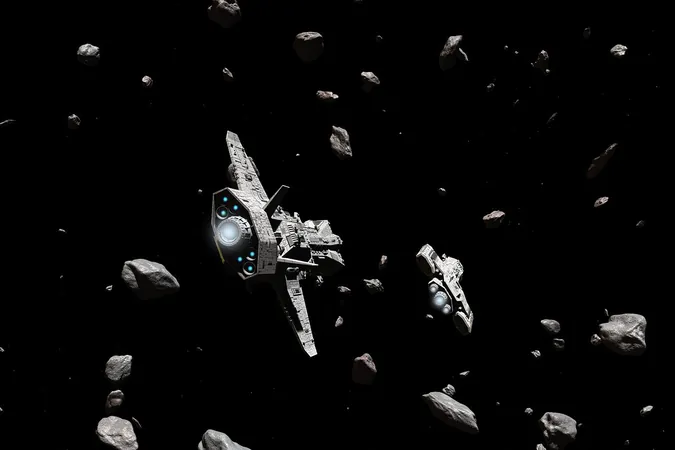
Navigating the Asteroid Belt: Is It as Dangerous as Movies Suggest?
2025-04-16
Author: Ming
We've all seen it in sci-fi films—a spaceship weaving through a perilous asteroid field, with rocks zooming dangerously close. But just how perilous is this scenario? Would a real spacecraft face imminent doom, or is it more fiction than fact?
The Reality of the Asteroid Belt
Contrary to cinematic portrayals, actual asteroid belts are not dense clusters of perilous rocks waiting to obliterate anything that dares enter. Our Solar System's main asteroid belt lies between Mars and Jupiter, with a staggering average distance of nearly 1 million kilometers (about 621,370 miles) between its asteroids.
To put that in perspective, that's 24 times the circumference of Earth! If seasoned pilots like Han Solo struggle in a fictional asteroid belt, they clearly face a dramatically different challenge than what exists in reality.
NASA's Successful Voyagers
NASA's missions tell a different story. Several spacecraft have bravely trekked through the asteroid belt without a hitch. Pioneer 10 made history when it passed through the belt in July 1972, navigating around 435 million kilometers before emerging unscathed in February 1973.
At that time, scientists were uncertain about the dangers posed by larger particles lurking in the belt, but Pioneer 10 triumphed—and it wasn't alone. A total of nine spacecraft, including the renowned Voyager 1 and 2, as well as Juno and New Horizons, have successfully navigated this vast expanse.
Discoveries Beyond Our Solar System
The quest doesn’t end there. Researchers have detected signs of asteroid belts around other stars, suggesting they exist across the galaxy—even though it's improbable anyone would need to dodge flying boulders like in the movies.
In fact, if these belts were as crowded as Hollywood suggests, they would constantly collide, creating debris and effectively turning into cosmic dust.
Planning Your Space Adventure?
So, if you’re contemplating a trip through the asteroid belt, fret not—NASA's findings indicate it’s not only possible but also relatively safe. With the right spacecraft and navigation techniques, you’re likely to emerge on the other side unscathed, ready for whatever space has in store!

 Brasil (PT)
 Canada (EN)
 Chile (ES)
 Česko (CS)
 대한민국 (KO)
 España (ES)
 France (FR)
 Hong Kong (EN)
 Italia (IT)
 日本 (JA)
 Magyarország (HU)
 Norge (NO)
 Polska (PL)
 Schweiz (DE)
 Singapore (EN)
 Sverige (SV)
 Suomi (FI)
 Türkiye (TR)
 الإمارات العربية المتحدة (AR)