New Study Uncovers Mars' Volcanic Past and Life Potential!
2025-04-19
Author: Wei Ling
Revolutionary Findings from Jezero Crater
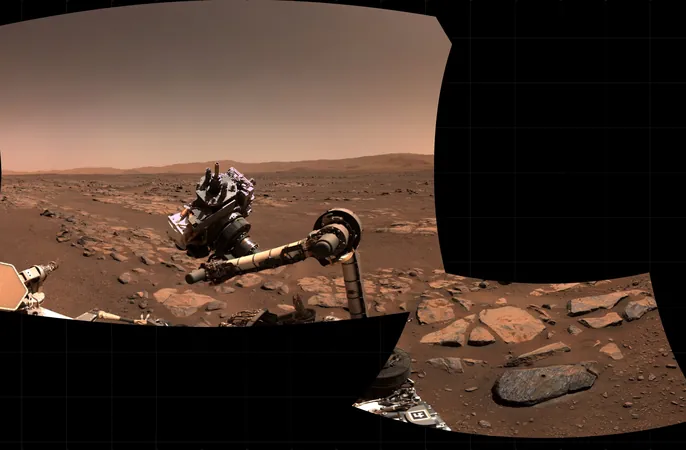
In an exciting revelation, researchers have unveiled a treasure trove of information about Mars's Jezero Crater, the site where NASA’s Perseverance rover landed. This groundbreaking study, featuring contributions from scientist Dr. Michael Tice at Texas A&M University, highlights a diverse collection of iron-rich volcanic rocks that could be key to understanding the planet's ancient history and its potential to harbor life.
Unlocking the Mysteries of the Red Planet
NASA's Perseverance rover, the most sophisticated robotic explorer ever sent to Mars, touched down on February 18, 2021, as part of its mission to seek historical signs of microbial life. The rover is diligently collecting Martian rock and soil samples for future analysis on Earth, making it a critical player in the quest for extraterrestrial life.
Cutting-Edge Technology at Work
Equipped with advanced tools, Perseverance is performing complex analyses of Martian geology. With its powerful cameras and spectrometers, including the Planetary Instrument for X-ray Lithochemistry (PIXL), scientists are dissecting the chemical makeup of the geological formations within Jezero Crater. Dr. Tice emphasizes the remarkable capabilities of these tools, stating, "It’s like having a mobile lab on another planet. We’re acquiring detailed chemical data and even microscopic textures like never before."
Secrets Hidden in the Rocks
The team’s analysis has uncovered two main types of volcanic rocks: dark, iron- and magnesium-rich varieties that incorporate minerals like pyroxene and plagioclase feldspar, and lighter-toned trachy-andesite featuring plagioclase crystals in a potassium-rich matrix. This complexity hints at a rich volcanic history, shaped by multiple lava flows.
Revolutionizing Our Understanding of Mars' History
Using innovative thermodynamic modeling, researchers have deduced that these unique rock compositions likely formed through high-degree fractional crystallization and interaction with Mars's crust. Dr. Tice notes that such processes, typically observed in active volcanic systems on Earth, suggest that this section of Mars experienced prolonged volcanic activity, potentially creating a favorable environment for ancient life.
A Step Closer to Discovering Life on Mars
These findings are more than just geological curiosities—they're crucial to understanding if Mars could have sustained life. With hopes pinned on the upcoming Mars Sample Return mission, a collaboration between NASA and the European Space Agency, these samples could soon journey back to Earth, allowing scientists to further unravel the planet's enigmatic past and hunt for biological markers.
Dr. Tice states, "By carefully selecting these rocks, we are unlocking the clues to Mars’s environments. Once we analyze them back on Earth, we can pose even more intricate questions about their history and potential biological significance." The future of Martian exploration has never looked so promising!

 Brasil (PT)
 Canada (EN)
 Chile (ES)
 Česko (CS)
 대한민국 (KO)
 España (ES)
 France (FR)
 Hong Kong (EN)
 Italia (IT)
 日本 (JA)
 Magyarország (HU)
 Norge (NO)
 Polska (PL)
 Schweiz (DE)
 Singapore (EN)
 Sverige (SV)
 Suomi (FI)
 Türkiye (TR)
 الإمارات العربية المتحدة (AR)