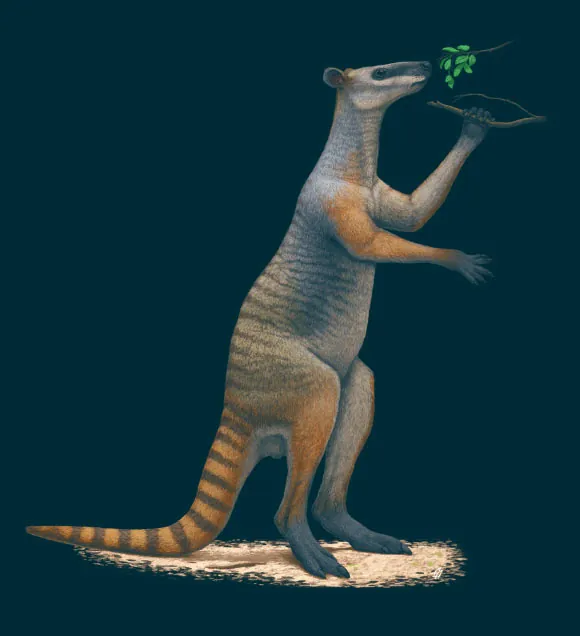
New Study Uncovers Secret Life of Giant Prehistoric Kangaroos: Did Their Homebodies Lead to Extinction?
2025-04-24
Author: Yu
Unveiling the Mystery of Ancient Kangaroo Behavior
In a groundbreaking revelation, researchers from the University of Wollongong and other institutions have discovered that the massive extinct kangaroos known as Protemnodon were not adventurous roamers of the Australian landscapes, but rather stayed close to home, challenging what was previously believed about these giant creatures.
The Surprising Findings from Fossil Analysis
This study, focusing on fossils unearthed from the Mt Etna Caves in Queensland, reveals that Protemnodon had a surprisingly limited foraging range, contrary to what one might expect for a creature weighing up to 170 kilograms. By analyzing strontium isotopes found in their teeth, researchers found connections only to local limestone formations, indicating these giant kangaroos dined exclusively on nearby vegetation.
Could Their Size Have Limited Mobility?
Previously, it was thought that larger body size in herbivores correlated with expansive roaming habits. However, this study suggests otherwise for these giant marsupials. Researchers believe that Protemnodon's bulk and body shape hindered its ability to hop for long distances, confining it largely to its immediate lush, rainforest environment.
Nature Takes Its Toll: Climate Change and Extinction
The research poses a deeply intriguing question: could such limited movement have led to their downfall? As the climate shifted and the rainforest habitat changed around 280,000 years ago, these kangaroos may have struggled to locate food, a deadly scenario that could have precipitated their extinction.
A Revolutionary Approach to Understanding Extinction
Dr. Scott Hocknull, a senior scientist at Queensland Museum, likened their innovative techniques to ancient GPS tracking, allowing researchers to map movements, diets, and interactions of these extinct species. This advancement enables a more nuanced understanding of the extinction narratives surrounding Australia's megafauna.
Looking Ahead: Future Research and What It Could Unveil
The team is eager to apply these advanced methods to other fossils discovered in the area, including various living descendants such as tree kangaroos and pademelons. This could illuminate how surviving species adapted to environmental fluctuations that once wiped out their gigantic relatives.
The Study's Impact on Paleoanthropology
Published in the journal PLoS ONE, this research not only adds a new layer to our understanding of Protemnodon but deepens the ongoing debate about the extinction of the Australian megafauna, providing vital data at both individual and species levels.

 Brasil (PT)
 Canada (EN)
 Chile (ES)
 Česko (CS)
 대한민국 (KO)
 España (ES)
 France (FR)
 Hong Kong (EN)
 Italia (IT)
 日本 (JA)
 Magyarország (HU)
 Norge (NO)
 Polska (PL)
 Schweiz (DE)
 Singapore (EN)
 Sverige (SV)
 Suomi (FI)
 Türkiye (TR)
 الإمارات العربية المتحدة (AR)