New Study Unveils Key Risk Factors for Dementia Linked to Daily Living Activities
2025-04-25
Author: Wei Ling
Groundbreaking Insights into Dementia Risks
A recent study has shifted the spotlight onto instrumental activities of daily living (IADL) limitations as significant predictors of dementia. As lifestyle evolves, so must our understanding of these risks. Here, researchers evaluated the National Center for Geriatrics and Gerontology Activities of Daily Living (NCGG-ADL), a newly developed scale, to assess how IADL limitations and mild cognitive impairment (MCI) collectively affect dementia onset.
Study Overview: A Closer Look at the Data
Conducted over five years, this longitudinal research encompassed 2,118 adults aged 65 and older, all free of dementia at the onset of the study. Through monthly follow-ups, they tracked incidents of dementia, while assessing participants’ daily living abilities and cognitive performance.
Striking Findings: IADL Limitations and Dementia Risk
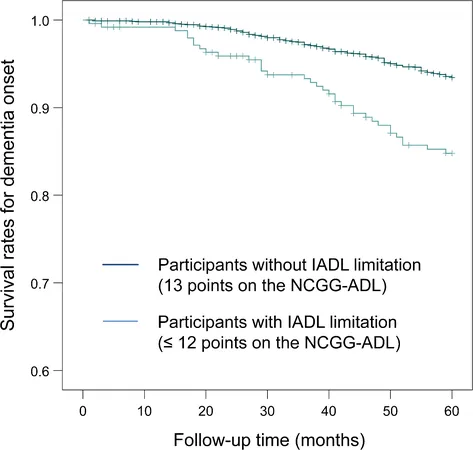
The results were startling: 11.7% of participants had IADL limitations at baseline, with 7.1% developing dementia within the five-year period. Those with IADL limitations bore a 55% greater risk of developing dementia compared to their peers without such limitations. Delving deeper, the study revealed different risk levels depending on cognitive functioning, illustrating that the combination of MCI and IADL limitations dramatically increases dementia risk.
Understanding IADLs: More Than Just Daily Tasks
IADLs encompass more complex functions like managing finances and using technology, compared to basic daily tasks like eating and bathing. These higher-level activities are often more sensitive indicators of cognitive decline, making their assessment critical in preemptive healthcare.
A Growing Concern: The Dangers of Population Aging
As the global population ages, the alarm on dementia grows louder, with forecasts predicting 82 million cases by 2030 and a staggering 152 million by 2050. This urgent scenario underscores the necessity for early intervention to mitigate the dementia risk.
Methodology: Rigorous Assessment and Follow-up
The study utilized a comprehensive assessment method, with participants evaluated based on their daily living tasks. The NCGG-ADL questionnaire includes essential activities like handling medications, using public transport, and even operating household appliances—essential in today’s technological landscape.
Conclusions: A Call to Action for Caregivers and Health Professionals
This research not only confirmed the NCGG-ADL scale as a valuable tool for assessing dementia risk but also emphasized the importance of recognizing the interplay between MCI and IADL limitations. Individuals demonstrating both conditions warrant heightened monitoring and proactive care to stave off dementia.
Future Directions: Addressing Limitations and Expanding Research
While the study's strengths include rigorous methodology and a solid participant pool, it identified a few limitations as well, such as the potential bias from participants without public insurance and the need for broader socioeconomic context in assessing IADLs. Future studies should aim to cover diverse populations to validate findings across cultures.
Implications for Society: Combatting Dementia Begins with Awareness
As society grapples with an aging population, findings like these could be pivotal in shaping targeted interventions and public health policies aimed at curbing the dementia epidemic. Identifying those at risk through daily living activities may just be the key to a healthier, more informed aging process.

 Brasil (PT)
 Canada (EN)
 Chile (ES)
 Česko (CS)
 대한민국 (KO)
 España (ES)
 France (FR)
 Hong Kong (EN)
 Italia (IT)
 日本 (JA)
 Magyarország (HU)
 Norge (NO)
 Polska (PL)
 Schweiz (DE)
 Singapore (EN)
 Sverige (SV)
 Suomi (FI)
 Türkiye (TR)
 الإمارات العربية المتحدة (AR)