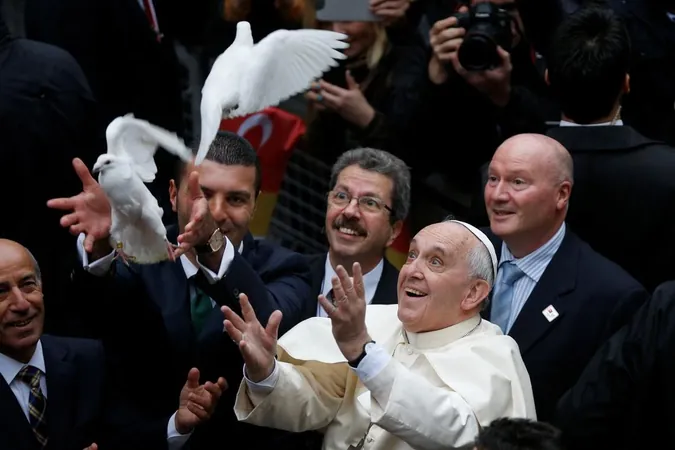
Pope Francis: The Revolutionary Pontiff Who Redefined Leadership
2025-04-21
Author: Wei Ling
The world mourns the passing of Pope Francis, who died on April 21 at the age of 88. He leaves behind a legacy as a groundbreaking leader, famously known as 'the people's pope.' His tenure marked a shift towards a more inclusive and compassionate Catholic Church, one that resonated with the marginalized and downtrodden, yet retained its historical doctrines.
Hailing from Argentina, Pope Francis was the first pontiff from the Americas and Southern Hemisphere. He staunchly advocated for the vulnerable—migrants and communities impacted by climate change—holding humanity accountable for the crisis facing the planet.
Despite his courageous confrontation of the church's sex abuse scandals, survivors voiced concerns over the pace of meaningful reforms.
Elected in March 2013, Jorge Mario Bergoglio adopted the name Francis, inspired by Saint Francis of Assisi, who devoted his life to the poor. His humble persona was characterized by simple robes, a rejection of the lavish papal lifestyle, and personal outreach, including phone calls to those in need.
Known for his love of sports, especially football, he embraced social issues, openly discussing topics like health and social media with youth. Although he contemplated the possibility of retirement–echoing his predecessor Benedict XVI—he consistently expressed that resigning should not become commonplace.
His declining health—marked by colon surgery and recurring bronchitis—led to speculation about his future role. However, he remained steadfast, emphasizing that papal resignations should be contemplated only under serious circumstances.
Pope Francis made headlines with powerful gestures that showcased his commitment to the underserved, including washing and kissing the feet of prisoners during Easter.
He chose to visit Lampedusa, a gateway for countless migrants, as his inaugural trip abroad, expressing concerns over the "globalization of indifference." His criticism of political leaders and their deportation plans highlighted his commitment to social justice.
A notable humanitarian, he took action by welcoming three families of Syrian Muslims into the Vatican during Europe’s migration crisis and sought reconciliation between faiths through historic meetings with religious leaders.
Pope Francis used his platform to influence global environmental policy, notably through his encyclical "Laudato Si," which called for urgent action on climate change, asserting that developed nations bore significant responsibility.
He vocally opposed the arms trade, framing global conflicts as part of a larger issue, at one point declaring that World War III was underway.
In his personal time, he practiced stress relief by penning letters to St. Joseph and found solace in music, particularly classical and tango.
Pope Francis rekindled interest in Catholic doctrine, approaching topics like gay rights with compassion, famously stating, "Who am I to judge?" He allowed divorced and remarried individuals to receive communion and blessed same-sex couples, though he ultimately faced criticism for maintaining traditional stances on celibacy and ordination for women.
His leadership was not without controversy, as notable conservative cardinals challenged his authority and direction. While initiating reforms within the Vatican and addressing clerical sexual abuse, critics noted that true accountability remained an ongoing struggle.
Born to Italian emigrants in Buenos Aires, his journey to the papacy was not conventional. After an early interest in chemical engineering and a brief stint as a club bouncer, he discovered his calling at the age of 17, despite a past ghosted by a near-fatal illness.
Serving as a priest and later as the provincial leader of the Jesuits in Argentina, he faced difficult scrutiny during his leadership amid Argentina’s military dictatorship, which would shape his complex legacy.
Ultimately, Pope Francis will be remembered as a revolutionary figure who bravely navigated the challenges of modernity, giving voice to the voiceless and inspiring a new vision for the global Church.



 Brasil (PT)
 Canada (EN)
 Chile (ES)
 Česko (CS)
 대한민국 (KO)
 España (ES)
 France (FR)
 Hong Kong (EN)
 Italia (IT)
 日本 (JA)
 Magyarország (HU)
 Norge (NO)
 Polska (PL)
 Schweiz (DE)
 Singapore (EN)
 Sverige (SV)
 Suomi (FI)
 Türkiye (TR)
 الإمارات العربية المتحدة (AR)