Revealing Mars’ Ancient Secrets: How Carbonates Uncover a Once Thriving Carbon Cycle
2025-04-20
Author: Arjun
Mars isn’t just a barren desert. Surprisingly, evidence from the Curiosity rover indicates that ancient Mars once boasted surface liquid water and a thick, carbon dioxide-rich atmosphere—conditions that could have supported a dynamic environment.
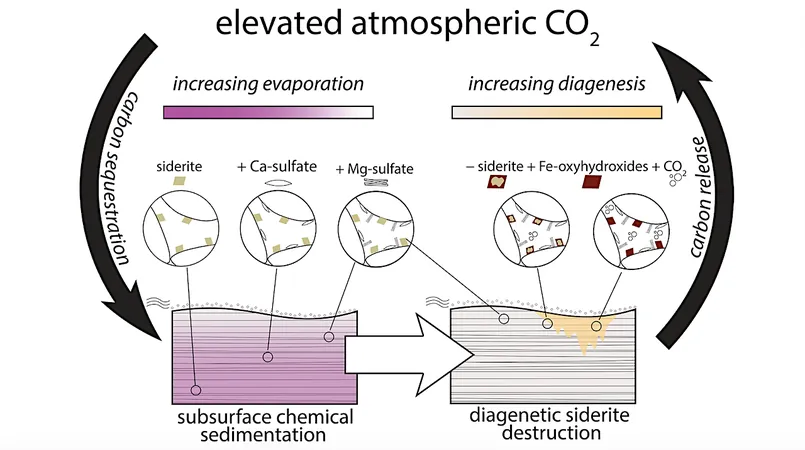
Recent analyses of an 89-meter section of Gale Crater reveal startling findings! Scientists discovered iron carbonate minerals, specifically siderite, present at levels ranging from 4.8% to 10.5%, found alongside highly soluble salts. This suggests that these minerals developed under water-limited conditions, driven by reactions between water and rock, followed by evaporation.
But what’s even more fascinating? These carbonate deposits are believed to have sequestered between 2.6 to 36 millibars of atmospheric CO2—illustrating how ancient Mars had a functioning carbon cycle.
Furthermore, the presence of iron oxyhydroxides in these deposits hints at a unique twist: some of the carbon that was previously trapped was eventually released back into the atmosphere. This dynamic interchange between the surface and atmosphere raises intriguing questions about Mars’ climatic past and its potential for harboring life.
With Curiosity’s ongoing exploration, we’re uncovering layers of Martian history, revealing not just a planet of dry rocks, but a complex world that once might have been. What other secrets lie hidden in the Martian soil waiting for discovery?

 Brasil (PT)
 Canada (EN)
 Chile (ES)
 Česko (CS)
 대한민국 (KO)
 España (ES)
 France (FR)
 Hong Kong (EN)
 Italia (IT)
 日本 (JA)
 Magyarország (HU)
 Norge (NO)
 Polska (PL)
 Schweiz (DE)
 Singapore (EN)
 Sverige (SV)
 Suomi (FI)
 Türkiye (TR)
 الإمارات العربية المتحدة (AR)