Revolutionary Breakthrough in Quantum Communication: New Nanophotonic Platform Supercharges Quantum Teleportation
2025-04-24
Author: Siti
Unleashing Quantum Potential
Imagine a future where quantum communication isn't just a distant dream but a reliable reality. Researchers have long believed that harnessing nonlinear optical processes could elevate quantum systems by enhancing fidelity and shielding them from common errors. Yet, previous attempts faced a significant hurdle—the need for extremely low light levels made practical implementation nearly impossible.
A Game-Changer from Illinois
Now, a groundbreaking team at the University of Illinois Urbana-Champaign has made waves in the field by integrating these nonlinear processes onto an innovative indium-gallium-phosphide nanophotonic platform. This leap in technology isn't just an upgrade—it's a game changer. In stark contrast to prior systems, which struggled with light levels, this new approach can effectively operate down to the level of single photons, the tiniest units of light.
Fidelity That Takes Quantum Communication to New Heights
Kejie Fang, a leading professor in electrical and computer engineering, touted their system's remarkable performance: "Our nonlinear system transmits quantum information with an astonishing 94% fidelity. In comparison, traditional systems using linear optics are bound by a theoretical limit of just 33%. This breakthrough showcases the immense potential of quantum communication powered by nonlinear optics."
Quantum Teleportation: A Glimpse into the Future
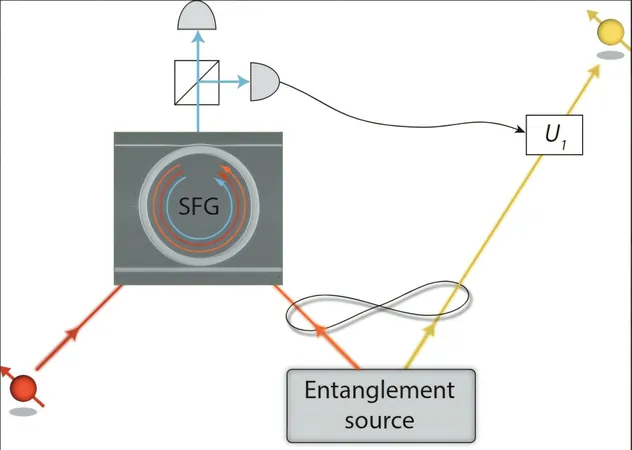
Central to transmitting quantum information is the complex protocol of quantum teleportation. Here, quantum entanglement comes into play, allowing two single photons to influence one another, bypassing traditional channels. This elegant method significantly reduces the effects of external noise and imperfections inherent to communication channels.
Tackling the Challenges of Quantum Communication
Despite the promise of quantum teleportation, two major limitations persist. First, standard linear optical components create ambiguities in transmission. Second, the entangled photons often suffer from errors and noise due to imperfect generation processes. Elizabeth Goldschmidt, a physics professor and study co-author, notes that traditional entanglement sources typically produce multiple photon pairs, muddying the waters of true entanglement.
Harnessing Nonlinear Optics to Combat Noise
Nonlinear optical components, however, can significantly mitigate this issue. By facilitating the combination of photons at different frequencies to generate new ones, these components offer a powerful solution. The utilized nonlinear process, known as "sum frequency generation" (SFG), adds two photon frequencies to create a new photon, effectively filtering out the predominant noise that plagues most entangled photon sources.
Breaking New Ground with Efficiency
Until now, successful application of SFG for quantum teleportation was rare, with success rates lingering at an unimpressive 1 in 100 million. Thanks to their cutting-edge nanophotonic platform, the Illinois researchers have turned the tide, boosting this efficiency drastically to an impressive 1 in 10,000—a 10,000-fold increase!
Looking Ahead: A Bright Future for Quantum Teleportation
With enthusiastic optimism, the researchers anticipate that further innovations in nonlinear optical components could soon propel quantum teleportation to even greater heights. This transformative approach isn't limited to teleportation alone; it holds vast potential across various quantum communication protocols, opening the door to a new era of quantum connectivity.


 Brasil (PT)
 Canada (EN)
 Chile (ES)
 Česko (CS)
 대한민국 (KO)
 España (ES)
 France (FR)
 Hong Kong (EN)
 Italia (IT)
 日本 (JA)
 Magyarország (HU)
 Norge (NO)
 Polska (PL)
 Schweiz (DE)
 Singapore (EN)
 Sverige (SV)
 Suomi (FI)
 Türkiye (TR)
 الإمارات العربية المتحدة (AR)